 English
- All
- Product Name
- Product Keyword
- Product Model
- Product Summary
- Product Description
- Multi Field Search
English


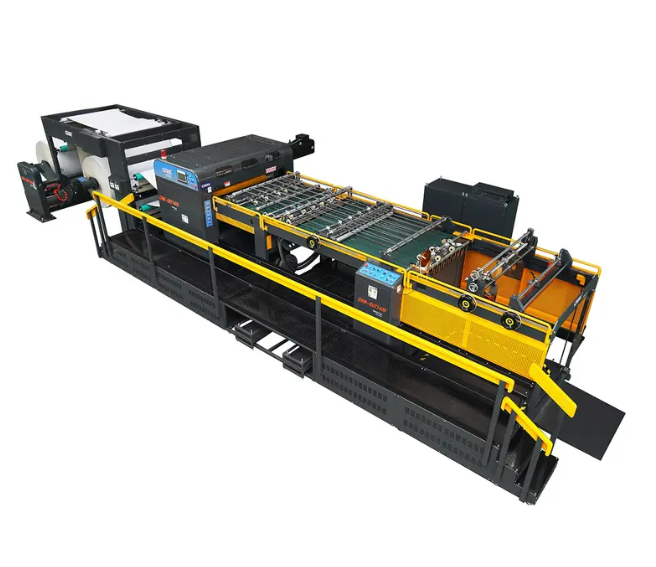
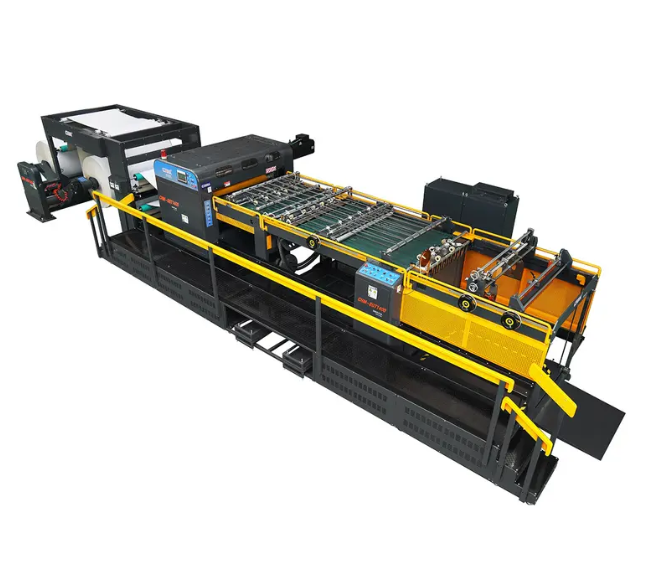

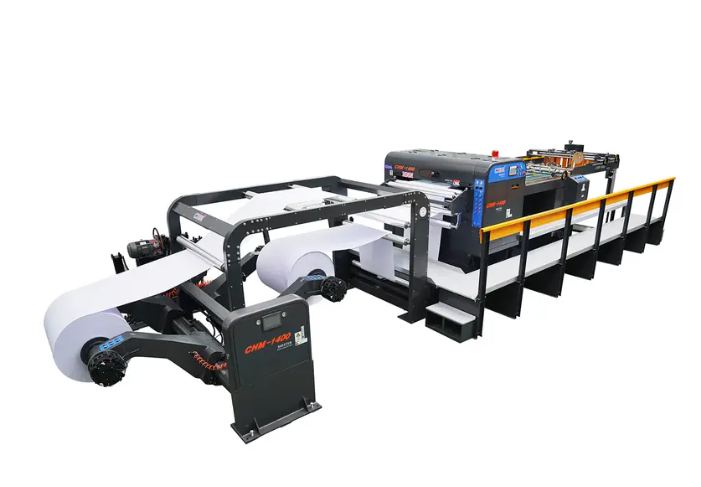


Designed for industrial roll-to-sheet production where stable sheet length, clean edges, and square stacks directly protect your printing or converting efficiency.
Rotary top-and-bottom blade cutting delivers a consistent, “crisp” cut feel at the edge, helping reduce fuzz and paper dust that can contaminate downstream processes.
Built for multi-roll cutting to keep long runs moving with fewer roll changes and fewer operator interventions.
Handles heavy stock confidently, supporting demanding board grades where curl, tension drift, and stacking instability often become costly problems.
Engineered as a system, not a single function: web handling, slitting, cross cutting, conveying, and stacking work together to produce sellable sheets, not just “cut sheets.”
| Quantity: | |
|---|---|


In a busy plant, the cost of sheeting isn’t only the machine—it's the hidden waste: trimmed edges that drift over time, stacks that lean and collapse, dust that coats sensors, and operators who slow the line just to stay safe. Automatic Paper Sheeting Machine With Automatic Cross Cutter is built to remove that daily friction and replace it with repeatable control.
From the moment the roll begins to unwind, the machine focuses on stability. The web runs with disciplined tension, stays aligned, and reaches the cutting section without the “soft wobble” that creates length variation and uneven trims. At the cutting point, top-and-bottom rotary blades deliver a steady cutting rhythm and a cleaner edge profile, helping finished sheets feel smoother along the cut line and look more consistent when stacked. After the cut, the line treats conveying and stacking as part of quality control: sheets are guided, overlapped, and delivered in a way that protects corners, keeps piles square, and helps you pack, palletize, or feed downstream equipment with fewer stops.
For B2B users, this translates into fewer rejected batches, fewer customer complaints about size variance or messy edges, and a more predictable production day.
Clean, confident cut quality that supports smoother downstream feeding and fewer edge-related defects
Production-ready speed capability for high-volume operations, while keeping cut length stable across runs
Multi-roll cutting option that reduces roll-change downtime and helps maintain throughput during peak order seasons
Web handling discipline that reduces drift, prevents unstable trims, and improves repeatability across long shifts
Slitting and waste management approach designed to keep trim removal continuous and the working area cleaner
Delivery focused on square, stable stacks so the output looks professional and packs faster with less manual correction
Operator-friendly setup logic that aims to shorten changeovers and reduce reliance on “operator experience” for basic stability
A stable roll-to-sheet line follows a predictable production logic, and this machine is designed around that logic to help you produce consistent sheets at scale.
Typical workflow
Unwinding and feeding
Web alignment control to reduce side drift
Tension control to stabilize the web as roll diameter changes
Slitting and trim removal to achieve your finished width
Cross cutting with top-and-bottom rotary blades
Multi-stage conveying to manage sheet separation and overlap
Counting and batching for packaging efficiency
Jogger stacking to keep piles square and shipment-ready
Why this matters
Many quality failures happen after the knife, not at the knife. By controlling the transition from cutting speed to stacking speed, you reduce skew, protect corners, and keep stacks neat.
A predictable flow also makes training easier: operators follow a system rather than improvising to correct drifting piles or unstable tension.
B2B buyers typically measure cut quality in three ways: edge condition, dimensional consistency, and how the sheets behave in downstream equipment. This machine is designed to support all three.
Edge condition
Rotary top-and-bottom blade cutting supports a cleaner cut profile with less “torn” texture at the edge, helping reduce fuzz and paper dust that can build up on sensors and rollers.
A cleaner edge also improves the feel of the finished sheet—particularly important for premium packaging board, art paper, and high-grammage sheets that will be handled repeatedly.
Dimensional consistency
Precision is not only a knife issue; it depends on web stability. The machine’s approach emphasizes stable web handling and controlled conveying to help length remain consistent across long runs.
The cutting accuracy specification is structured by length range, supporting both shorter and longer formats in a way that matches real production usage.
Downstream behavior
Sheets that are cut cleanly and delivered square are easier to feed, easier to align, and less likely to jam in printing or converting equipment.
This reduces micro-stoppages that quietly destroy productivity over a shift.
Roll-to-sheet production is sensitive to curl, tension drift, and side tracking. When those variables are not controlled, you see trim loss, length variation, and unstable stacks. This machine addresses those real-world risks with a stability-first philosophy.
Key stability ideas
Tension control supports consistent feeding behavior as the roll unwinds and the roll diameter changes.
Alignment control supports stable tracking, helping reduce “walking” that can cause uneven trims and stacks that gradually drift out of square.
The machine is built for heavier grammage operation, where stability is non-negotiable and small disturbances become large defects quickly.
Practical benefits for B2B operations
Less trim waste caused by drift
Fewer sheet length issues during long runs
More stable stacking that reduces repacking and customer claims
Lower operator stress, because the line feels predictable instead of fragile
Waste handling is not a side detail in sheeting—it is a productivity system. Trim that is not removed smoothly creates jams, marks sheets, and forces stoppages that cost far more than the material itself.
How the system supports cleaner production
Adjustable slitting allows you to match different finished widths without rebuilding the line logic.
Trim removal is designed to stay continuous, helping prevent waste build-up that can touch the sheet surface or interrupt movement.
A cleaner waste path supports a cleaner floor, less manual clearing, and more consistent shift-to-shift performance.
What buyers typically gain
More stable output quality when running wide rolls with frequent width changes
Reduced risk of sheet surface marks caused by loose trim
Less downtime caused by waste collection problems
In many factories, the “sellable product” is defined at the delivery end, not at the cutting end. A stack that leans, fans out, or arrives with damaged corners creates labor and customer risk.
Delivery goals
Separate sheets reliably after the cut
Overlap and convey in a controlled way
Keep piles square and dense for faster packaging
Maintain consistent counts for batching and shipment confidence
Why stacks matter in B2B shipping
Square stacks wrap faster and ship safer
Neat edges signal process control and build customer trust
Better piles reduce corner damage and reduce claims
Stable delivery reduces operator rework and improves line flow
Typical use cases
Printing and paper processing operations that require stable sheet feeding and consistent size
Packaging and converting plants producing carton board sheets, laminated packaging sheets, and specialty paper formats
Stationery manufacturers producing writing paper, pads, and cut-size formats where neat stacks and accurate counts reduce customer complaints
Plants handling higher grammage sheets where curl and stability issues are more likely to disrupt production
How to judge if it’s right for your line
You run long shifts and need stable output quality across time
You want fewer operator interventions and fewer quality surprises
Your downstream equipment is sensitive to sheet squareness and edge condition
You want to reduce waste, rework, and manual stack correction
| Parameter | Value |
|---|---|
| Model | CHM-SGT1400 |
| Cutting Type | Top and bottom blade rotation |
| Paper Weight | 200–1000 GSM |
| Roll Diameter | Max 1800mm (71") |
| Finished Width | Max 1400mm (55") |
| Finished Length | Min 450mm, Max 1450mm |
| Rolls Cut | Multi-roll cutting |
| Cutting Accuracy | ±0.5mm (L<1000mm), ±0.1% (L≥1000mm) |
| Max Cutting Speed | 300 sheets/min, 300m/min |
| Air Pressure | 0.8 MPa |
| Voltage | AC380V/220Vx50Hz |
| Total Power | 77KW |
| Output | Depends on material and paper weight |
B2B buyers don’t only purchase a machine—they purchase delivery capability. Our approach focuses on helping you run stable production, reduce rework, and maintain consistent output quality across shifts.
What you can expect
A production-focused configuration mindset that prioritizes stability, cut quality, and delivery control rather than only peak speed numbers
Clear, practical communication around what impacts output: paper type, grammage, curl, roll diameter, and stacking requirements
Documentation and support designed for real factory usage, helping your operators run the system consistently instead of relying on personal habits
Service continuity planning so small issues do not become long stoppages, including guidance on maintenance routines and spare parts preparation
It supports 200–1000 GSM, suitable for heavier paper and board grades where stability and cut quality are critical.
Cutting accuracy is specified by length range: ±0.5mm when cutting length is under 1000mm, and ±0.1% for lengths equal to or above 1000mm.
Finished width is up to 1400mm. Finished length ranges from 450mm to 1450mm, covering many common and custom formats.
The rated maximum is 300 sheets per minute and 300 meters per minute. Real output depends on material type, paper weight, and the stability requirements of stacking and batching.
Yes. Multi-roll cutting is designed to reduce roll-change downtime and support higher effective throughput in continuous production.
Air pressure is 0.8 MPa. Power options include AC380V/220V at 50Hz, with a total installed power of 77KW.
Prepare your target paper types and GSM range, maximum roll diameter, required finished sheet sizes, target output per shift, and whether you need special batching, counting, or stacking requirements.
The automatic paper slitting machine with automatic cross cutter is designed for high-precision cutting and efficient paper handling. It features an adjustable slitting system that provides flexible paper width and precise cutting performance.


