 English
- All
- Product Name
- Product Keyword
- Product Model
- Product Summary
- Product Description
- Multi Field Search
English


Views: 0 Author: Site Editor Publish Time: 2025-06-16 Origin: Site


The operation of a paper sheeting machine involves several interconnected steps, each essential to transforming large rolls of paper into precise, uniform sheets ready for further processing or sale. Understanding the workflow helps to appreciate the complexity and technological sophistication behind what might seem like a straightforward cutting process.
At a high level, the workflow begins with loading the large paper roll onto the machine. The roll is unwound carefully to feed the continuous paper web into the cutting section. Along the path, the machine controls the paper tension precisely to avoid wrinkles, tears, or slack that could affect cutting quality. Once tension is stabilized, the paper moves to the cutting system, where it is sliced according to programmed dimensions, whether by a single knife, rotary blades, or helical cutters.
After cutting, the sheets are conveyed downstream for stacking and packaging, often with automated systems ensuring neat alignment and consistent output. Throughout the process, sensors and control units monitor parameters like web speed, tension, and sheet length, allowing for real-time adjustments and ensuring quality and efficiency.
The paper roll feeding system is the machine's starting point and a critical factor in maintaining cutting precision. Typically, a jumbo roll of paper, weighing several hundred kilograms, is mounted on a shaft called the unwind stand. This shaft is designed to rotate smoothly, allowing the paper roll to unwind without excessive resistance.
Proper tension control during unwinding is vital. If the tension is too high, the paper can stretch or tear; if too low, it may wrinkle or feed unevenly. Modern paper sheeting machines incorporate sophisticated tension control systems, including:
Dancer rollers: These are movable rollers that absorb fluctuations in paper tension by moving up or down, adjusting to maintain consistent tension.
Load cells: Sensors that measure the tension force exerted on the paper web, providing feedback to the control system.
Brake and drive motors: These control the speed of the unwind roll and downstream rollers to keep the paper taut but not overstressed.
Together, these components form a closed-loop control system that continuously monitors and adjusts tension, ensuring the paper web feeds smoothly and evenly into the cutting section.
The feeding path often includes web guiding systems that keep the paper aligned laterally, preventing edge deviation and ensuring that cuts are straight and uniform across the sheet width.
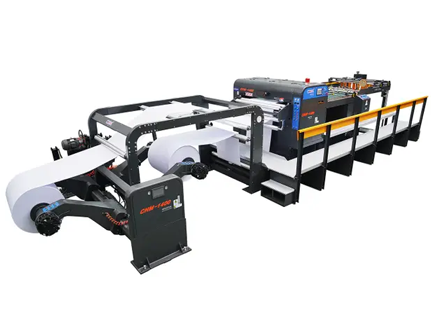
The cutting mechanism is the heart of any paper sheeting machine, determining the precision, speed, and quality of the finished sheets. Different cutting technologies are used depending on the paper type, production volume, and required sheet quality.
1. Single Knife Cutting (Guillotine Style)
This traditional method uses a large, straight blade that descends vertically onto the paper web resting on a fixed bed. The paper stops momentarily during the cut, allowing the knife to shear cleanly through the material. This technique is especially suitable for thick paperboards, cardboard, or specialty sheets that require precise, burr-free edges. The advantage lies in its sharp, square cuts and simplicity, but its disadvantage is a slower speed compared to rotary systems due to the stop-and-cut operation.
2. Dual Knife Rotary Cutting
In high-speed production environments, rotary cutting with dual knives is common. Here, two cylindrical blades rotate in opposite directions, shearing the paper continuously as it moves through the machine. This allows for seamless, continuous cutting without stopping the paper feed, dramatically increasing output rates. It’s particularly effective for medium to lightweight papers where maintaining web tension is critical. The dual rotary knives produce clean edges and can handle high volumes efficiently.
3. Helical (Spiral) Cutting
Helical cutting technology employs spiral-shaped blades that engage with the paper web in a smooth, gradual slicing motion rather than a direct shear. This method reduces mechanical stress on the paper, minimizing deformation and edge fraying. It’s ideal for delicate or coated papers and is often integrated into premium sheeting machines. Helical cutters also provide extended blade life and quieter operation due to the reduced impact forces.
Each cutting method balances speed, precision, and paper type suitability, allowing manufacturers to select or customize machines based on their specific production needs.
After sheets are cut to the required size, they must be transported and stacked efficiently to maintain their quality and prepare them for packaging or further processing.
Conveying System
The newly cut sheets are first transferred onto a conveyor system, which typically consists of smooth belts or rollers designed to handle delicate paper without causing damage. This system moves sheets gently and rapidly away from the cutting zone to prevent jams or pileups.
Advanced sheeting machines use vacuum conveyors or air flotation tables to reduce friction and prevent sheets from sticking or scratching each other, especially when dealing with glossy or coated papers.
Stacking System
Once conveyed, sheets arrive at the stacking area where they are neatly piled into stacks of predefined quantities. Automated stackers use mechanical guides and joggers that gently align sheets by nudging their edges into perfect registration, eliminating misalignment that could cause issues downstream.
Some machines have dual stacking stations that allow continuous operation — while one stack is being removed, the machine deposits sheets on the other stacker. This minimizes downtime and improves overall productivity.
Additionally, sensors monitor stack height and alignment to trigger alerts or stop the machine if anomalies occur, ensuring consistent quality.
Together, the conveying and stacking systems provide a seamless transition from cut sheet to packaged product, crucial for maintaining sheet integrity and reducing labor costs.
Modern paper sheeting machines are equipped with advanced automation control systems that significantly enhance operational efficiency and reduce human error. These systems integrate programmable logic controllers (PLCs), human-machine interfaces (HMIs), and sensor networks to create a highly responsive production environment.
The PLC acts as the brain of the machine, executing pre-programmed cutting sequences, adjusting feed rates, and coordinating the various components such as the unwind stand, cutting blades, and conveyors. Operators can easily input specific sheet sizes, cutting patterns, and production speeds via touch-screen HMIs, enabling fast setup changes and reducing downtime.
Intelligent monitoring plays a crucial role in maintaining continuous production quality. Sensors continuously measure parameters such as paper tension, web speed, blade sharpness, and sheet alignment. If any deviation beyond set thresholds is detected, the system can alert operators or automatically adjust machine settings to compensate. This real-time feedback loop prevents defects, reduces waste, and ensures consistent output.
Some machines also integrate remote monitoring capabilities, allowing technicians to access machine status and diagnostics via the internet. This feature facilitates proactive maintenance, troubleshooting, and software updates without the need for on-site intervention.
Precision is paramount in paper sheeting applications, as inaccurate cuts can cause downstream problems like misalignment in printing or packaging. Paper sheeting machines use multiple mechanisms to guarantee dimensional accuracy and high cutting quality.
Firstly, precise web guiding systems ensure that the paper feed remains perfectly aligned horizontally, preventing skewed cuts. Secondly, cutting blades are manufactured and maintained to exacting standards, with options for automatic blade sharpening or quick-change systems to minimize wear-related issues.
Advanced machines also utilize length measurement devices such as encoder wheels or laser sensors that measure the paper length between cuts with high accuracy, enabling consistent sheet sizes within tight tolerances.
To verify quality, some systems incorporate inspection cameras or sensors that detect defects like edge irregularities, wrinkles, or paper breaks immediately after cutting. These quality control measures enable operators to halt production if necessary and avoid processing defective sheets further, thereby saving material and time.
In today’s highly competitive paper processing industry, combining mechanization with intelligent control systems is key to achieving stable and high-quality production. Paper sheeting machines efficiently convert large paper rolls into precise sheets with speed and consistency far surpassing manual methods. Utilizing automated controls, real-time monitoring, and advanced quality assurance, manufacturers can minimize waste, boost output, and ensure consistent product quality even under demanding conditions.
For businesses aiming to enhance their paper processing capabilities, Dong Guan Chun Hing Mechanical Technology Co., Ltd. offers advanced, reliable, and customizable paper sheeting machines designed to meet modern industrial needs. Their expert team provides tailored solutions that improve operational efficiency and support sustainable growth.
To explore their innovative products or discuss how a paper sheeting machine can optimize your production, visit their website at www.chmpapersheeter.com or contact them directly. Taking this step can elevate your manufacturing performance and secure a competitive advantage in the market.


