 English
- All
- Product Name
- Product Keyword
- Product Model
- Product Summary
- Product Description
- Multi Field Search
English


Views: 0 Author: Site Editor Publish Time: 2026-07-07 Origin: Site


Scaling paper conversion requires transitioning from standalone cutting processes to fully integrated, continuous-flow operations. Global paper demand places immense pressure on modern converting plants today. They must maximize daily yields while keeping operational bottlenecks completely isolated. The primary challenge involves balancing high-speed throughput against exact dimensional tolerances and zero-defect packaging. Minor misalignments routinely cause significant material waste across the production line. They also frustrate downstream distributors who expect flawless ream presentations every single time.
This article provides plant managers and procurement teams an objective, practical framework. You will learn how to evaluate an A4 copy paper cutting and wrapping machine effectively. We specifically focus on workflow integration, technical viability, and deployment realities on the factory floor. By understanding these mechanical nuances, you avoid common purchasing mistakes. You will walk away prepared to optimize your production lines and increase output sustainability.
Industrial paper rolls often weigh several tons. Unwinding them safely demands precise, automated control systems. Modern plants use pneumatic braking combined with advanced edge position control (EPC). These specific systems dictate downstream cutting precision entirely. If web tension fluctuates, the paper stretches or sags unpredictably. This ruins the final sheet dimensions. Quality machines utilize load cells to monitor tension continuously. They feed data back to the pneumatic brakes for rapid, real-time adjustments. Consistent tension ensures a flawless web progression into the slitter.
The paper web moves directly from unwind stations into the primary cutting section. Rotary slitting knives divide the wide web longitudinally into precise A4 widths. Next, cross-cutting cylinders shear these continuous strips horizontally. You must prioritize knife durability and strict tolerance control here. The global converting industry demands a dimensional tolerance of ±0.2mm per sheet. Tungsten carbide knives offer extended lifespans compared to standard hardened steel. They require far fewer sharpening intervals. This material upgrade keeps your production line running longer.
Cut sheets exit the cross-cutter at tremendous speeds. Without physical intervention, they would crash into the collecting unit and instantly jam. Sheet overlap mechanisms solve this physical challenge effectively. Fast-moving vacuum belts grab the leading edge of each cut sheet. They slow the sheet down precisely. This allows the subsequent sheet to slide underneath smoothly. It forms a neat shingle pattern. Conveyors then transport this overlapped paper stream smoothly toward the automated stacking area.
Collecting stations gather the shingled sheets into precise stacks. Once a stack reaches 500 sheets, mechanical pushers discharge it immediately. They move the stack onto the transfer belt. This creates the most critical handover point in the factory. The cutter must synchronize perfectly to the downstream A4 ream wrapping line. If the wrapper pauses briefly, the cutter needs accumulator buffers. Precise timing prevents catastrophic collisions between freshly cut reams. Proper transfer synchronization minimizes unnecessary machine stops.
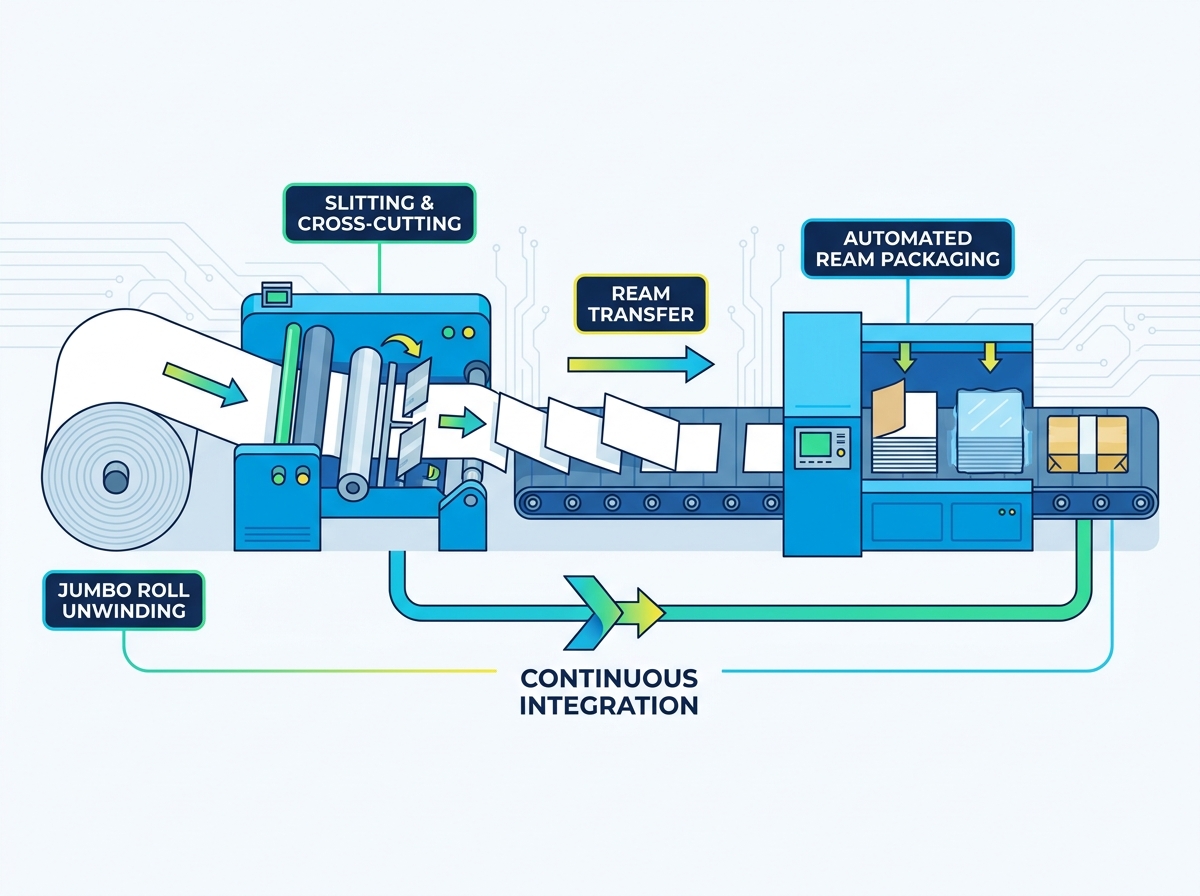
Machine suppliers often highlight theoretical maximum speeds. You must look past these numbers to calculate net operational yields. Evaluating a A4 paper converter requires mapping realistic production days. Theoretical speed assumes endless paper and zero faults. Operational reality includes paper web breaks, roll changeovers, and glue refills. High-performing plants differentiate between the two metrics clearly.
| Evaluation Metric | Theoretical Capacity | Operational Throughput (Actual) |
|---|---|---|
| Definition | Maximum machine cycles per minute. | Actual salable reams produced per shift. |
| Variables Ignored | Roll changes, web breaks, maintenance stops. | None. Accounts for all planned and unplanned downtime. |
| Typical Range | 40–60 Reams / Minute | 28–45 Reams / Minute |
| Best Practice | Use for baseline mechanical capability checks. | Use for yield forecasting and shift planning. |
Consumer trust relies entirely on accurate sheet counts. High-quality converting lines use advanced infrared sensors. These sensors count overlapping sheets as they enter the collecting unit. Unreliable sensors cause over-counts or under-counts frequently. You must evaluate the machine's automated rejection mechanisms. A reliable system kicks out bad reams automatically before wrapping begins. It removes them without stopping the entire upstream cutter. This saves tremendous time and preserves overall throughput.
Global markets demand flexibility in paper weights. Your equipment must handle different GSM variations seamlessly. Typical copy paper ranges between 70g and 80g per square meter. A rigid machine requires manual recalibration when switching weights. Recalibration forces lengthy downtime. You should assess material compatibility by reviewing several specific handling factors:
Modern paper converting relies on Programmable Logic Controllers (PLCs). They act as the central brain of the production line. Centralized touch-screen diagnostics remain an absolute necessity today. When a fault occurs, operators need instant visual feedback. A good HMI (Human-Machine Interface) pinpoints the exact sensor failure. It reduces troubleshooting from hours to mere minutes. Minimal operator intervention defines a truly efficient line. Look for systems featuring intuitive menu structures and automated fault logging.
Packaging requirements change based on regional market demands. Your packaging unit needs robust material adaptability. It must seamlessly process laminated paper, BOPP film, or printed poly wrappers. Some markets prefer the eco-friendly appeal of coated paper. Others demand the moisture barrier provided by plastic films. Most machines are material-agnostic fundamentally. However, changing between BOPP film and poly-coated paper requires heating profile adjustments. You want an interface that saves these temperature recipes automatically.
The wrapper sealing process directly impacts shelf life and aesthetic appeal. Hot-melt glue systems dominate the traditional paper wrapper market. You must assess actual glue consumption rates during evaluation. Inefficient nozzles waste expensive adhesive and cause messy seal lines. Alternatively, ultrasonic or thermal sealing methods work best for BOPP films. Check the seal integrity under pressure. Weak seals pop open during transit. High-quality automated ream packaging systems ensure tight, squared corners and imperceptible glue lines.
Ream wrapping represents only one part of the packaging journey. Finished reams must move securely into shipping cartons. Linking the wrapper to automated carton erecting modules creates immense value. You eliminate severe manual labor bottlenecks here. An integrated line pushes wrapped reams directly into carton fillers. It then passes the filled boxes through automated strapping machines. Evaluating this downstream integration determines your actual shipping readiness. Ensure the outfeed conveyor matches the carton erector's intake height perfectly.
Line synchronization heavily depends on speed differentials. Wrapping speeds must safely exceed upstream cutting output. If the cutter produces 30 reams per minute, the wrapper should handle 35. This buffer prevents dangerous accumulator jams. When a wrapper stops for a roll change, the cutter usually continues briefly. It stores sheets in an accumulator. Once the wrapper restarts, it must clear that backlog quickly. If the wrapper lacks surplus speed, the entire line eventually halts.
High-speed converting lines command massive physical footprints. You must address these space requirements long before delivery. A standard line stretches over 20 meters in length. Beyond the machine itself, you need raw material staging areas. Jumbo rolls require heavy forklift access routes. Finished goods demand spacious outfeed zones for palletizing. We strongly recommend mapping the layout using 3D CAD software. This prevents catastrophic clearances issues near factory support columns.
Deploying heavy machinery requires meticulous site preparation. Installation timelines routinely stretch beyond initial expectations. Plant readiness dictates the success of final commissioning. You must execute several prerequisite steps before technicians arrive:
Technology upgrades often intimidate existing workforce teams. Transitioning from manual or semi-auto processes to highly synchronized lines creates a steep learning curve. Operators must shift from physical laborers to process supervisors. They need extensive training on PLC interfaces and tension control theory. Rushing this training phase guarantees low initial yields. We suggest running overlapping shifts during commissioning. This allows operators to learn fault recovery techniques under expert vendor supervision.
Even the most robust equipment eventually requires maintenance. You must evaluate the vendor’s Service Level Agreement (SLA) rigorously. Remote diagnostic support prevents minor software glitches from causing major downtime. Technicians can securely log into your PLC to reset faults from afar. Furthermore, localized spare parts availability remains crucial. Waiting three weeks for a proprietary cross-cutting blade paralyzes a factory. Choose a copy paper production machine supplier who maintains regional parts depots.
| Implementation Risk | Common Cause | Mitigation Strategy |
|---|---|---|
| Vibration Issues | Uneven or weak concrete foundation. | Verify floor load-bearing capacity before installation. |
| Pneumatic Drops | Undersized factory air compressors. | Install a dedicated air reservoir tank near the unwinder. |
| Software Faults | Operator unfamiliarity with HMI. | Mandate minimum 40-hour hands-on vendor training. |
A high-performing converting line goes far beyond raw cutting speed. It represents the perfect synchronization of web tension control, precise sheeting, and uninterrupted packaging. When you integrate these stages flawlessly, material waste drops significantly. Daily yields stabilize, and product presentation meets global distributor standards. You must approach the procurement process strategically.
Prioritize vendors offering transparent performance guarantees and verifiable case studies. Look for modular equipment designs. They allow easy upgrade paths as your production volumes grow. Never compromise on PLC diagnostics or local spare parts availability. Your next critical steps include requesting targeted machine demonstrations. You should acquire sample output testing using your own jumbo rolls. Finally, negotiate strict Service Level Agreements to secure long-term operational peace of mind.
A: Typical mid-range machines produce 10–25 reams per minute. Heavy-duty industrial lines can exceed 40–50 reams per minute. The exact output depends heavily on the number of unwinding rolls processing simultaneously.
A: Yes. Most modern packaging units are essentially material-agnostic. However, changing between BOPP film and poly-coated paper requires specific physical changeovers. You must adjust the heating profiles and gluing mechanisms accordingly.
A: Depending on plant readiness and machine complexity, installation generally takes time. Final commissioning usually requires 15 to 30 days of active on-site work by vendor technicians.
A: The most common issues include paper web breaks caused by poor raw material tension. Additionally, hot-melt glue nozzle blockages and sensor misalignments at the critical ream transfer point cause frequent micro-stops.


