 English
- All
- Product Name
- Product Keyword
- Product Model
- Product Summary
- Product Description
- Multi Field Search
English


Views: 0 Author: Site Editor Publish Time: 2026-06-30 Origin: Site


Converting high-GSM substrates creates significant operational bottlenecks. Operators frequently struggle to process thick kraft paper and heavy paperboard efficiently. You cannot sacrifice production speed or edge quality during long manufacturing runs. Standard sheeters perform adequately for lightweight copy paper. Industrial packaging materials, however, require entirely different mechanical approaches. Heavy substrates demand immense shear force. They also require continuous web tension control.
Robust decurling mechanics prevent material jams. Uncontrolled webs lead to excessive waste and unplanned downtime. This article outlines a comprehensive equipment evaluation framework. We help you align machine specifications against facility production goals. Selecting the right machinery minimizes unexpected mechanical failures. It maximizes your overall material yield and keeps operations moving.
Material Specificity: Processing kraft and paperboard demands robust tension control and decurling units to prevent web breaks and sheet curling.
Technology Choice: A rotary knife paper sheeter eliminates the stop-and-go bottlenecks of traditional guillotine cutters, enabling continuous, high-speed production.
Blade Configuration: For thick paperboard (typically over 250 GSM), a dual blade paper cutter (synchronous rotary) is heavily recommended over single-rotary models to prevent edge beveling and reduce dust.
Implementation Risk: Buyer evaluations must account for heavy foundation requirements, floor space constraints, and the learning curve associated with advanced PLC (Programmable Logic Controller) systems.
Cutting heavy packaging substrates pushes standard equipment beyond physical limits. High-GSM materials naturally resist shearing forces. Kraft paper contains long, tough pine fibers. These fibers dull conventional blades quickly. Fixed blades experience rapid, uneven wear during continuous operation. Constant friction generates excessive airborne paper dust. Dimensional inaccuracy creeps into the process at higher operating speeds. Operators often notice sheet variations during extended shifts.
Substandard cutting creates cascading failures across the production floor. Edge cracking ruins structural integrity. This damage destroys final folding cartons. Dust contamination poses massive risks for sensitive orders. Food-grade packaging strictly forbids particulate contamination. Dust also ruins downstream printing operations. Particulates stick to offset printing blankets. This causes ink voids and forces operators to reject entire batches. Uneven sheet sizes jam high-speed press feeders constantly.
Your facility needs a reliable paperboard cutting machine to eliminate these bottlenecks. The equipment must deliver perfectly clean edges. Exact squareness remains a rigid requirement for automated processing. You should demand a strict ±0.5mm tolerance across all sheet sizes. Operations must sustain high speeds constantly. Frequent blade changes disrupt workflow and frustrate floor managers. You need continuous, reliable output to maintain production schedules.
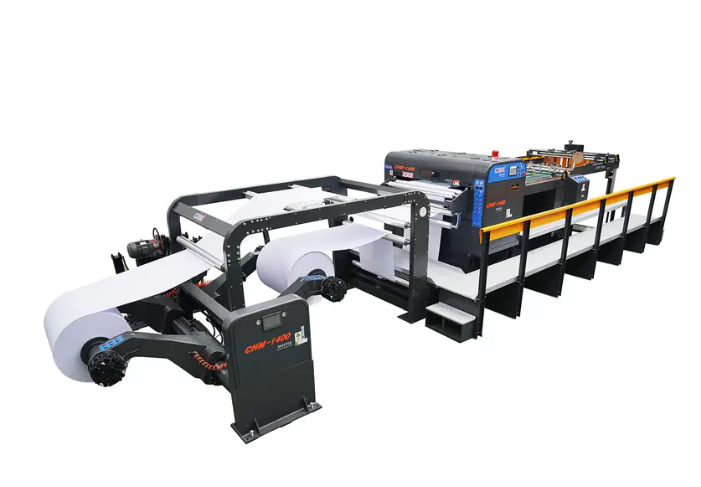
Understanding blade mechanics helps you choose the correct equipment. Single rotary machines utilize one rotating top blade. It cuts against a fixed bottom anvil blade. We see this configuration often in standard converting facilities. It works well for lighter kraft paper. Operations running thin materials benefit from this mechanical simplicity. However, thicker boards expose severe mechanical limitations. The fixed blade resists the moving web. This squeezes the tough fibers before severing them. You get a noticeable bevel on the cut edge. Maximum GSM thresholds remain relatively low.
Synchronous dual rotary mechanics differ drastically. Two knife cylinders rotate together continuously. They synchronize perfectly to the web speed. They cut the material like a flying scissor. This suits heavy paperboard perfectly. Coated folding cartons require this exact precision. You can process multiple rolls simultaneously using this method. Zero speed difference exists at the precise cut point. The material never buckles or accumulates behind the blade. You achieve a perfectly square cut every time.
A synchronous dual blade paper cutter eliminates edge beveling completely. It severs the fibers cleanly without dragging. This drastically reduces airborne paper dust. We recommend comparing these configurations directly based on material profiles.
Configuration Comparison Chart | ||
Evaluation Metric | Single Rotary Configuration | Synchronous Dual Rotary Configuration |
|---|---|---|
Cutting Mechanism | One rotating blade against a fixed anvil | Two rotating cylinders acting as scissors |
Edge Quality | Slight beveling on thicker materials | Perfectly square, clean edge |
Maximum Capacity | Up to 300-400 GSM optimally | Handles 1000+ GSM comfortably |
Dust Generation | Moderate to high due to friction | Minimal, ideal for cleanroom environments |
Ideal Applications | Light packaging, standard copy paper | Heavy folding cartons, multi-roll sheeting |
Selecting reliable equipment requires inspecting specific mechanical sub-systems. Do not rely solely on top-line speed specifications. Look closely at how the machine handles the physical material.
Jumbo rolls exert massive inertia during operation. Managing web tension prevents unexpected material snapping. Modern machines utilize load cells. These cells monitor tension constantly. Pneumatic brakes adjust the unwind resistance automatically. High-GSM materials hold a strong curl memory. You need heavy-duty decurlers. Multiple decurl bars break the material memory effectively. Sheets must lay perfectly flat. Flat sheets ensure stable stacking.
Unwind stands dictate changeover efficiency directly. Evaluate the maximum roll diameter carefully. Heavy kraft rolls require robust structural support. We highly recommend shaftless unwind stands.
They utilize hydraulic arms to lift rolls into place.
Operators avoid heavy manual lifting completely.
Chuck mechanisms secure the roll core safely.
This reduces operator fatigue significantly.
Manufacturers often list maximum cuts per minute. However, real throughput depends on cut length. Processing a 500mm sheet yields different line speeds than a 1000mm sheet. Material thickness alters these metrics further. The knife cylinder circumference remains fixed. The machine alters web speed to change sheet lengths. We advise calculating realistic daily volumes. Look beyond peak theoretical speeds.
Cutting inherently generates fine particulates. Vacuum systems capture this dust immediately at the knife edge. Static elimination bars neutralize electrical charges on the web. Removing static prevents dust from clinging to the paperboard. Food-grade applications mandate these extraction systems. A modern kraft paper sheeter integrates these features directly. They remain non-negotiable for clean manufacturing operations.
Procuring the machine represents only the first phase. Physical installation dictates long-term success. Heavy machinery requires extensive site preparation. You must align the equipment physically and digitally.
Installing a heavy-duty rotary paper sheeting machine requires precise site preparation. High-speed cutting generates significant kinetic energy. Heavy-duty models require reinforced concrete foundations. Standard factory floors often lack the necessary density. Concrete dampens mechanical vibrations effectively. Vibration control maintains strict cutting accuracy over time. You must allocate adequate floor space for the machine footprint. Ensure operators have clearance for safe roll loading.
Floor Assessment: Verify concrete density and vibration isolation parameters.
Utility Routing: Install high-capacity pneumatic air lines and industrial power conduits.
Downstream Alignment: Position automated stackers and vibrating joggers to receive sheets seamlessly.
Conveyor Syncing: Integrate pallet delivery systems to remove finished stacks without stopping production.
Mechanical adjustment dials belong to the past. Modern systems utilize advanced digital PLC interfaces. Touchscreens control every operational parameter now. Vendor-provided training ensures smooth technology adoption. Operators must learn tension feedback parameters. They need to set cut lengths digitally. Troubleshooting software alarm codes requires systematic training. Facility managers must schedule dedicated learning time.
Rotary knives eventually dull despite robust engineering. Outline the expected lifespan of these blades clearly. Plan for sharpening intervals carefully. Keep spare knife cassettes ready on site. Swapping cassettes reduces machine downtime dramatically. Operators must clean the decurling rollers regularly. Maintain the pneumatic brake pads to ensure consistent tension. Proactive maintenance prevents catastrophic web breaks.
Choosing a manufacturing partner requires rigorous validation. Marketing brochures rarely tell the entire story. You must demand empirical proof of machine capability.
Ask for documented performance case studies. They must match your specific GSM ranges. Review their experience running identical material types. Contact their previous clients directly. Ask about actual uptime percentages. Inquire about the vendor's responsiveness during emergencies.
A Factory Acceptance Test proves machine capability definitively. Send your actual jumbo rolls to the vendor facility. The manufacturer must run a live test. Verify the cut tolerance in person. Check the sustained operating speed. Inspect the finished stack quality carefully. A reliable rotary knife paper sheeter manufacturer welcomes this intense scrutiny.
Remote PLC diagnostics save critical production time. Engineers can troubleshoot software issues globally via secure VPN connections. Local spare parts warehousing minimizes physical shipping delays. Production halts hurt delivery schedules severely. Reliable service networks keep your operations moving forward.
Choosing the right equipment requires balancing operational needs carefully. Evaluate the machine capabilities against your long-term material yield goals. Upgraded systems reduce manual labor requirements significantly. Dual-rotary systems provide verifiable performance benefits across the board. They handle heavy paperboard efficiently without stalling. Edge quality improves drastically, protecting downstream printing operations. Maintenance intervals become highly predictable.
Audit your current waste metrics closely today. Identify where fixed blades cause excessive downtime. Consult a machinery engineer soon to map out your specific unwind configurations. Define your exact stacking requirements before initiating vendor discussions. Taking these proactive steps ensures a smooth, highly productive installation.
A: Standard single-rotary machines typically handle up to 300-400 GSM reliably. Heavy-duty synchronous dual-rotary models can comfortably process upwards of 1000 GSM. The exact maximum depends heavily on the specific material density, structural stiffness, and the mechanical rating of the cutting cylinders.
A: It utilizes a synchronized, scissor-like cutting action. Two rotating blades sever the paper fibers cleanly at the exact speed of the moving web. This eliminates the crushing, scraping, and shearing friction typical of fixed-blade configurations, which are the primary causes of airborne paper dust.
A: Yes. Many industrial machines offer multiple unwind stands, holding anywhere from two to six rolls. You can sheet several webs at once. This configuration multiplies overall throughput exponentially, provided the combined GSM of all webs does not exceed the rated capacity of the cutting cylinder.


