 English
- All
- Product Name
- Product Keyword
- Product Model
- Product Summary
- Product Description
- Multi Field Search
English


Views: 0 Author: Site Editor Publish Time: 2026-07-02 Origin: Site


Edge quality is not merely a cosmetic preference. It stands as a critical operational metric in modern production facilities. Ragged edges, slitter dust, and dimensional variations directly trigger downstream press jams. They also cause highly expensive rejected batches that frustrate demanding clients. Upgrading or replacing finishing equipment requires looking far beyond mere throughput speeds. The true return on investment of a modern commercial paper sheeting machine lies in its ability to deliver flawless edge control. You need consistent performance across diverse paper substrates, from lightweight films to heavy boards. This guide breaks down the essential mechanical requirements for achieving zero-defect edge precision. We explore core evaluation criteria and practical implementation realities on the factory floor. You will learn exactly how to optimize your production lines. We will also show you how to evaluate modern cutting technologies effectively. Mastering these concepts prevents costly operational bottlenecks. Read closely to transform your conversion process completely.
Attaining consistently clean cut paper edges requires synchronized web tension control, precise blade metallurgy, and robust decurling mechanics.
The shift from legacy systems to a modern rotary sheeting machine significantly reduces edge dusting and improves cut-to-mark tolerances.
Partnering with the right commercial paper converter equipment manufacturer involves verifying production scalability and post-installation support.
We must treat edge quality as a primary financial driver. Poorly cut paper does more than look bad. It actively damages your profitability. Let us examine the cascading effects of poor edge control.
Downstream Equipment Failures
Edge dust creates massive, compounding problems for subsequent printing phases. Microscopic paper burrs routinely contaminate offset printing blankets. They also clog sensitive digital print heads in modern inkjet presses. This contamination forces operators to halt production unexpectedly. You face excessive maintenance stops just to clean the equipment. Industry benchmarks show that excessive blanket washes drastically reduce daily output. A dirty edge essentially paralyzes your high-speed printing presses. Furthermore, the abrasive nature of paper dust accelerates wear on delicate machine components. This leads to premature part replacements and spiraling maintenance budgets.
Material Waste & Rejection Rates
Inadequate paper sheet accuracy directly leads to out-of-square sheets. Modern commercial printers cannot tolerate dimensional variations. Even a fraction of a millimeter of deviation causes registration errors during multi-color printing. Clients will quickly reject entire pallets of uneven paper. These rejections compromise your profit margins instantly. Wasted material costs add up rapidly when processing expensive coated stocks or specialty laminates. You lose both the raw material and the expensive labor invested in the conversion process.
OEE (Overall Equipment Effectiveness) Drag
Older machines often struggle to maintain acceptable edge quality at high operational speeds. Operators typically slow these machines down deliberately to compensate for vibration and blade wear. This speed reduction hides a massive financial drag within your facility. It artificially lowers your Overall Equipment Effectiveness (OEE). Running a sheeting machine at 60% capacity just to get clean edges is inherently inefficient. We see many facilities bleeding potential revenue due to this hidden compromise. You cannot maximize your facility's output if you constantly fight your own equipment.
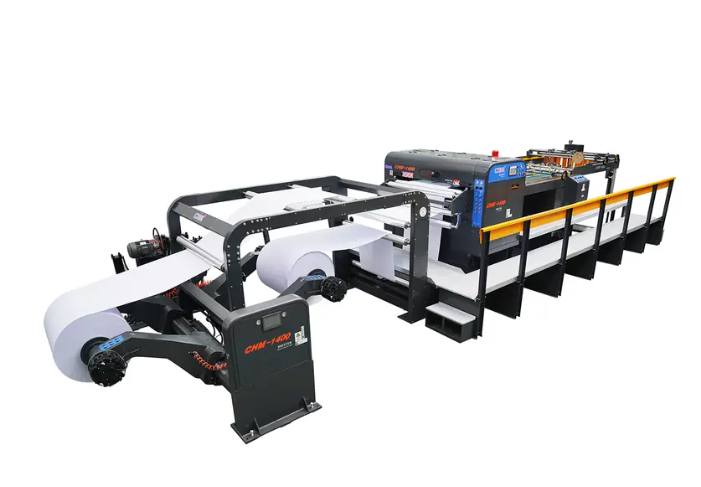
Achieving clean cut paper edges demands precise mechanical execution. You cannot rely on outdated cutting methods. Modern technology relies on specific physical principles to sever paper cleanly.
Legacy guillotine setups use a brute-force crushing motion. A single heavy blade chops down onto a stationary cutting block. This creates a severe "crush" effect on the delicate paper fibers. It generates significant dust and leaves a jagged microscopic edge along the cut line. Conversely, a modern rotary sheeting machine utilizes advanced twin rotary knives. These rotating steel cylinders house precision blades that meet perfectly in mid-air. They deliver a scissor-like, fully synchronized cut. The blades match the exact forward speed of the moving paper web. This synchronization eliminates tearing, stretching, and crushing entirely. The result is a hospital-clean edge that passes the strictest quality inspections.
Longitudinal cuts determine the exact width of your final sheets. You typically encounter three primary slitting methods in commercial paper conversion:
Razor Slitting: Uses a static, razor-sharp blade. It works adequately for very thin plastic films but wears out quickly on paper fibers.
Crush Cut Slitting: A blunt circular blade presses the paper hard against a hardened steel anvil cylinder. It creates heavy dust and poor edge quality.
Shear Slitting: Uses two rotating circular knives, an upper and a lower blade. They overlap slightly, mimicking the action of hand scissors.
Shear slitting stands as the definitive commercial standard. It handles heavy-duty, continuous operations flawlessly. We strongly recommend shear slitting for high-volume paper sheeting lines. It prevents fiber pull-out and ensures a crisp, dust-free edge across all paper grades.
Blade material dictates edge longevity and overall cut quality. Standard high-speed steel (HSS) offers decent performance for standard bond paper. However, highly abrasive substrates like recycled board degrade HSS rapidly. Carbide-tipped blades provide far superior wear resistance. They maintain their micro-edge significantly longer, reducing changeout frequency. You must also match the blade bevel angle perfectly to your paper grade. Heavyweight materials require a steeper, more robust bevel to penetrate the thickness. Lighter stocks benefit from a shallower, razor-like angle. Incorrect geometry causes severe edge deflection and premature blade failure.
Blade Metallurgy Comparison | |||
Blade Material | Ideal Substrates | Edge Longevity | Initial Investment |
|---|---|---|---|
High-Speed Steel (HSS) | Standard bond, uncoated paper | Moderate | Low to Medium |
Carbide-Tipped | Recycled board, coated stock | Very High | High |
Powdered Metallurgy | Heavy kraft, specialty laminates | High | High |
You must evaluate specific subsystems when upgrading your facility. A fast machine is useless if it delivers poor sheet accuracy. Focus on these critical mechanical areas.
Precise, automated tension zones are completely non-negotiable for high-end conversion. Proper tension prevents the paper web from weaving side to side as it unwinds. It ensures perfectly square cuts every single time. Look for advanced closed-loop load cell integration. These highly sensitive sensors measure web tension constantly. They feed digital data back to the braking system in real-time milliseconds. This automated adjustment maintains perfectly uniform tension from a massive full roll right down to the cardboard core.
Paper stored tightly on rolls naturally develops a persistent curve. You must neutralize this roll set curl prior to the cutting station. Advanced decurling units bend the web over adjustable, small-diameter breaker bars. This targeted physical action breaks the structural memory of the paper fibers permanently. It is completely mandatory for maintaining dimensional stability. A flat delivery ensures sheets stack perfectly on the outgoing pallet, ready for immediate downstream processing.
Even the sharpest metallurgical blades generate trace amounts of paper dust. You must remove this debris immediately from the cutting zone. Integrated dust extraction at the slitter and cross-cut stations is absolutely vital. High-velocity vacuum systems pull dust away before it settles onto the sheet surface. This feature is especially critical for food-grade or medical-grade packaging. It also helps modern facilities maintain strict clean-room compliance and protects operator respiratory health.
Manual slitter adjustment consumes highly valuable production time. Operators must measure, position, and lock blades completely by hand. This manual process introduces severe human error into the dimensions. Motor-driven, digitally controlled slitters offer immense operational value. They automatically move to precise lateral positions based on pre-programmed digital job recipes. This automation slashes make-ready times dramatically between runs. It eliminates spacing errors entirely and ensures perfect edge alignment across the entire web width.
Equipment Evaluation Summary Chart | |||
System Component | Legacy Capability | Modern Standard Requirement | Impact on Edge Quality |
|---|---|---|---|
Tension Control | Manual pneumatic brakes | Closed-loop load cells | Prevents web weaving and skewed cuts |
Decurling | Static breaker bars | Motorized, multi-roll decurlers | Ensures flat delivery and perfect stacking |
Dust Removal | Ambient air collection | Integrated high-velocity vacuum | Eliminates microscopic surface contamination |
Knife Positioning | Manual tape measure | Automated CNC positioning | Guarantees exact longitudinal dimensions |
Purchasing top-tier equipment represents only the first step. You must manage the physical and operational transition carefully. Poor implementation can ruin the benefits of an advanced sheeting line.
You must address the stark physical realities of integrating commercial sheeting lines. These massive machines require substantial factory floor space. Consider your existing floor plans carefully before finalizing a purchase. You need adequate clearance for heavy material handling equipment. Operators need wide, safe spaces for roll in-feed utilizing massive clamp trucks. They also require perfectly clear paths for forklift pallet out-feed. Cramped layouts inevitably lead to damaged rolls and severe safety hazards. Plan your workflow meticulously to minimize material transport distances.
Transitioning to advanced CNC-controlled sheet cutters requires significant operational upskilling. Your veteran operators must move from manual mechanical adjustments to sophisticated digital interfaces. Acknowledge this vital skill gap early in the integration process. Look for equipment featuring a highly intuitive Human-Machine Interface (HMI). Bright touchscreens with simple recipe-driven job recall simplify complex setups. They allow operators to save successful tension and length parameters for repeat jobs. Comprehensive, on-site vendor training is vital to bridge this technological gap successfully.
Precision mechanics demand rigorous, unyielding upkeep. You need realistic expectations regarding demanding maintenance schedules. Establish strict blade sharpening intervals based heavily on your specific production volume. A dull blade ruins paper sheet accuracy almost instantly. Enforce regular, scheduled lubrication cycles for all high-speed moving assemblies. You must also schedule routine calibration of your delicate tension sensors. Predictive maintenance prevents catastrophic unexpected downtime. It ensures your machinery consistently delivers peak mechanical precision year after year.
Selecting the right manufacturer dictates your long-term success. You are entering a partnership, not just making a transaction. Evaluate vendors rigorously to ensure lasting technical support.
Never buy heavy equipment based solely on a glossy brochure. We advise buyers to demand extensive, rigorous material trials. A reputable commercial paper converter equipment manufacturer will welcome this mechanical challenge. Send them your most difficult, problematic substrates. They should demonstrate cutting your specific materials flawlessly in their facility. Insist on verifying the final edge quality at normal operational speeds. A slow-speed demonstration easily hides severe vibration and tension flaws that will destroy your production.
Machine downtime destroys profitability with terrifying speed. Highlight the severe operational risk of proprietary mechanical parts. If a highly specialized motor fails, you cannot wait three weeks for an overseas shipment. Favor vendors who utilize high off-the-shelf component use. Standardized PLCs, common bearings, and ubiquitous pneumatic valves ensure rapid local replacements. Furthermore, demand guaranteed field technician response times. Your Service Level Agreement (SLA) must outline explicit, legally binding support metrics to protect your investment.
Industrial sheeting involves exposed high-speed blades and massive in-running pinch points. You must verify strict, documented compliance with international safety regulations. Look for CE, UL, or OSHA certifications depending entirely on your operational region. Pay specific attention to physical machine guarding and light curtains. Interlocked safety doors should immediately halt all operation if opened mid-run. Verify the strategic placement and instant responsiveness of emergency stops. Additionally, evaluate noise mitigation enclosures around the primary cutting stations to protect worker hearing.
Edge control stands as the ultimate indicator of sheeting machine health. It directly reflects the overall mechanical capability and maintenance level of your facility. Ragged edges indicate deep, underlying systemic failures requiring immediate attention. Conversely, perfectly clean cuts signal a well-maintained, highly optimized operation. We strongly advise decision-makers to prioritize core cutting mechanisms heavily. Value synchronized rotary cutting and robust tension control far over raw maximum speed specifications. Top speed means absolutely nothing if the resulting sheets face immediate client rejection. We encourage you to audit your current material waste metrics thoroughly. Identify exactly how much edge damage costs your business on a monthly basis. Then, reach out to a qualified equipment manufacturer. Request a custom material trial to see the transformative difference firsthand. Take decisive action today to eliminate edge defects completely.
A: Edge dusting typically stems from three primary issues. Dull slitter blades tear the fibers rather than cutting them cleanly. Improper blade overlap or incorrect over-speed settings cause a crushing action. Finally, inadequate vacuum extraction allows microscopic debris to settle back onto the web. Resolving these mechanical faults eliminates most dust.
A: Sharpening intervals depend entirely on your substrate abrasiveness and blade material. Standard steel blades cutting uncoated bond paper may last several weeks. However, cutting highly abrasive recycled boards can dull steel blades in days. Upgrading to carbide-tipped blades extends sharpening intervals significantly, often lasting months even under heavy production loads.
A: Modern equipment easily achieves industry benchmarks of +/- 0.15mm to 0.5mm variance. This tolerance depends slightly on the total sheet length and operational speed. Maintaining this tight accuracy relies heavily on continuous closed-loop tension control. Without proper tension, the web drifts, and dimensional accuracy deteriorates rapidly.
A: Sometimes. You can often upgrade slitter sections or install modern digital tension controllers on older frames. However, you cannot easily fix fundamental cross-cut limitations. A legacy guillotine cutter will never achieve rotary precision. True commercial-grade edge perfection usually requires a full machine replacement to upgrade the core cutting mechanics.


