 English
- All
- Product Name
- Product Keyword
- Product Model
- Product Summary
- Product Description
- Multi Field Search
English


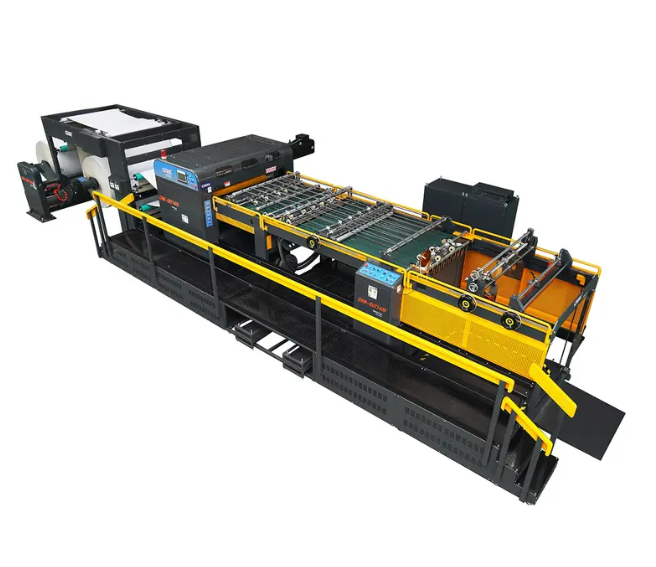
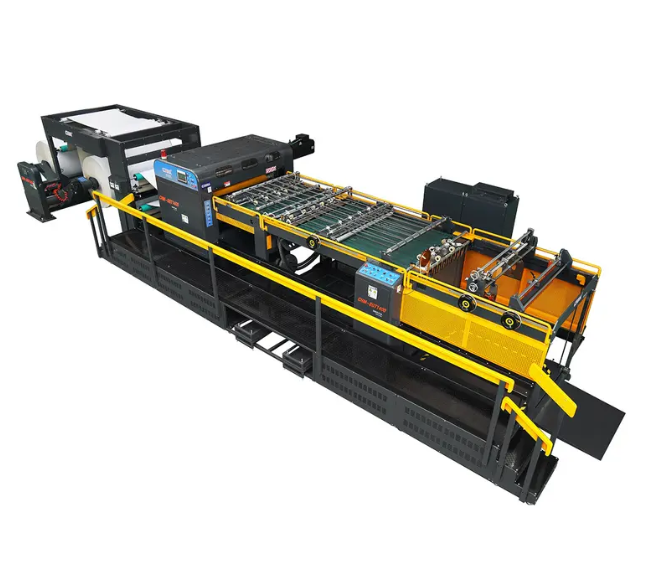

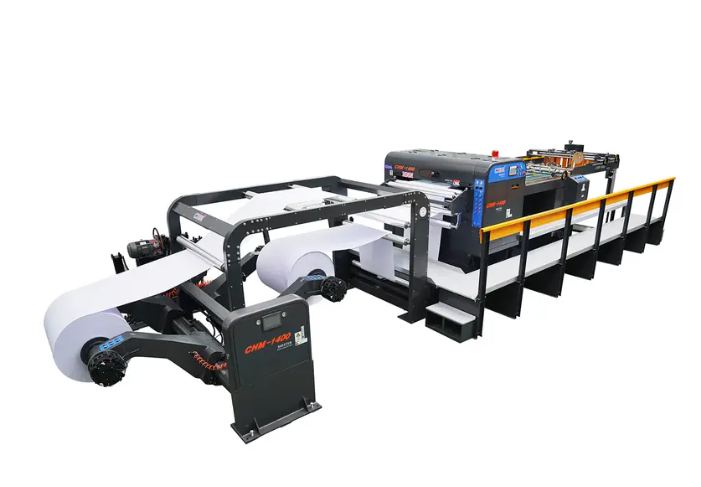


Purpose: Convert paper rolls into consistent, sale-ready sheets for printing, packaging, and paper converting operations.
Cutting system: Double rotating blades for stable, repeatable sheeting.
Material range: 60–1000 GSM, from lightweight printing paper to thick board-like grades.
Speed capability: Up to 300 cuts/min and 300 m/min line speed, depending on model and job.
Cut length range: 450–1450 mm for SM-1100/SM-1400; 450–1600 mm for SM-1700.
Roll handling: Max roll diameter 1500 mm for SM-1100/SM-1400; 1800 mm for SM-1700.
Air requirement: 0.8 MPa for smooth pneumatic actions and stable operation.
Build: Gray/White or custom color, pallet packaging for export logistics.
| Quantity: | |
|---|---|


A commercial paper sheeter is one of those machines you can sense before you see the finished result: the steady hum of synchronized drives, the crisp, controlled “kiss” of rotary blades, and the soft, rhythmic landing of sheets into a neat pile. This High Precision Commercial Paper Sheeting Machine is built for factories that win business with consistency—consistent sheet length, clean edges, square stacks, and changeovers that don’t steal hours from your schedule.
Imagine a packaging plant switching from a 700 mm sheet order to a 1200 mm run for a new customer. Without a stable sheeter, you end up with drifting lengths, uneven stacks, and a quiet trail of scrap that looks small per pallet but becomes expensive over a month. This machine is designed to reduce those invisible losses. It supports a wide GSM range of 60–1000 and production speeds up to 300 cuts/min and 300 m/min line speed, while maintaining accuracy rules that match real converting practice. The result is a sheet you can feel: edges that are tidy, corners that stay aligned, and piles that feed smoothly into guillotines, laminators, and packing stations without constant manual “rescues.”
Less waste, fewer re-runs: Stable sheeting reduces the need for trimming and re-stacking downstream, protecting both material yield and labor efficiency.
A wider order mix: One machine family supports 60–1000 GSM, helping you accept more job types without rebuilding your workflow.
More output per shift: High speed capability boosts conversion capacity so roll inventory turns into shipped product faster.
Repeatability across operators: Computerized control supports consistent setup and monitoring, reducing shift-to-shift variability.
Cleaner stacks for better finishing: Defined stack height capability supports more stable palletizing and less handling damage.
Export-ready practicality: Pallet packaging simplifies loading, protection, and warehouse handling.
This machine is built for commercial converting environments where sheet consistency directly affects customer satisfaction and downstream efficiency. Typical users include printing plants, packaging converters, paper merchants, and integrated mills that supply cut-size sheets. It’s especially valuable when your order mix changes frequently—today coated paper for offset printing, tomorrow kraft-like packaging grades, and next week heavier sheets for specialty products.
The 60–1000 GSM range gives your operation more negotiating room. When customers ask for thicker grades, you don’t want to answer with hesitation or “maybe.” Thick material behaves differently: it carries more stiffness, makes a sharper sound at the cut, and amplifies any tension instability. A sheeter that can handle broad GSM ranges helps you standardize capability, shorten quoting cycles, and reduce the risk of failed trials. The output is also more “presentable” in a B2B sense—uniform edges, consistent stiffness sheet-to-sheet, and stacks that look professional when unpacked by a print shop or a packaging line.
Precision only matters if it stays steady when production reality changes—different operators, different GSM, different roll batches, and speed ramps during long runs. This machine defines accuracy by cut-length category, which reflects how converting teams evaluate performance:
For sheet length at or below 1000 mm: ±0.2 mm
For sheet length above 1000 mm: ±0.1%
This structure is practical because long sheets naturally magnify small deviations. With defined accuracy rules, you can predict whether a run will remain compatible with printing registration, laminating alignment, and consistent packing dimensions. That predictability is the foundation of trust in B2B supply relationships.
Cut quality is also sensory. A clean sheet edge should feel crisp and uniform, not fuzzy or torn. Double rotating blades support continuous, controlled cutting action, helping reduce shock and vibration that can show up as rough edges or unstable piles. Over time, improved cut consistency reduces the “hidden cost” of finishing—less trimming, fewer rejected stacks, and fewer stoppages due to misfeeds caused by irregular edges.
For B2B buyers, productivity is the combination of speed, stability, and how often you must stop to correct problems. This machine supports a maximum cutting speed of 300 cuts/min and a maximum cutting line speed of 300 m/min. Those numbers help estimate capacity, but the operational value comes from controlled output—maintaining accuracy while accelerating and decelerating so you can run efficiently without constantly slowing down to protect quality.
In practice, you can optimize differently by job type. Shorter sheet lengths benefit from higher cut frequency, while longer sheets are more influenced by line speed and web handling stability. When output remains predictable, scheduling becomes easier: fewer buffer hours, fewer last-minute overtime shifts, and fewer late shipments caused by scrap piles that fail downstream checks. That’s the kind of advantage that doesn’t just improve production statistics—it improves your credibility with customers who care about consistent sheet quality on every delivery.
Most scrap begins before the blade. If the web wanders, tension fluctuates, or roll handling becomes inconsistent, it shows up as length drift, skewed piles, and edge misalignment. This machine defines roll handling in a practical way so your operation stays predictable:
Maximum roll diameter: 1500 mm for SM-1100/SM-1400, 1800 mm for SM-1700
Input paper width options: 1100, 1400, 1700, 1900 mm by model family
These ranges support better procurement planning because you can standardize roll sourcing and handling equipment. Operators also benefit: instead of “listening for trouble,” they can run stable jobs with fewer manual interventions. When the web stays calm, the cut stays consistent, and the stack stays square. The required 0.8 MPa air pressure should be viewed as a quality input—stable pneumatic performance supports smooth motion control and reduces inconsistency in key actions that affect sheeting stability.
Commercial sheeting often runs across multiple shifts, and the biggest risk is not only mechanical—it is human variability. Computerized control helps turn good operation into repeatable operation. Instead of relying on one senior operator’s experience, your team can standardize setups and reduce variability between shifts.
A practical control approach supports:
Consistent job setup that can be repeated for re-orders
Clear monitoring and status visibility so issues are addressed early
Flexible voltage specification options to match plant utilities and expansion plans
The value is measurable in B2B terms: fewer quality disputes, more consistent acceptance by downstream lines, and a more stable production routine that scales as your team grows. When your sheeting process becomes predictable, your customer commitments become easier to keep.
A sheet is only “finished” when it can be handled, transported, and processed without becoming messy. This machine supports defined stacking capability:
Maximum paper stack height: 1300 mm for SM-1100/SM-1400, 1500 mm for SM-1700
Higher and more stable stacks reduce labor because you change pallets less often and interrupt production less frequently. More importantly, controlled stacking improves downstream compatibility. Square piles feed better, strap better, and ship better. When a customer opens a shipment and sees uniform, well-aligned stacks, it reinforces confidence in your supply quality. Sensory cues matter here: sheets land with a consistent rhythm, edges align visually, and the strapped pile feels solid with less shifting and fewer corner damages.
In commercial converting, reliability is measured in uninterrupted hours and predictable output, not just total machine life. A solid structure supports stable operation at high speeds and high stack heights, helping reduce vibration-related quality drift over time. Reliability also protects your schedule: fewer emergency stoppages mean fewer missed dispatch windows.
Maintenance should be planned rather than reactive. A practical maintenance rhythm focuses on:
Blade condition monitoring to protect edge quality and consistency
Web contact points inspection to prevent drift and scuffing
Pneumatic stability checks aligned with the 0.8 MPa requirement
Many plants also find that air quality and stability upgrades produce immediate improvements in consistency. When air pressure is steady and clean, pneumatic actions become more repeatable, which supports stable sheeting performance. This is a simple but often overlooked way to protect both quality and uptime.
Every converting plant has a different order mix, roll sourcing pattern, and downstream workflow. This machine family is designed to be selected and configured by practical constraints rather than guesswork. Start with model selection based on width and roll handling needs:
SM-1100 for 1100 mm input width
SM-1400 for 1400 mm input width
SM-1700 for 1700 mm input width with larger roll diameter capacity
SM-1900 for 1900 mm width requirement
Then align configuration details to your plant standards:
Voltage matching such as 380V 50Hz or custom
Color options such as Gray/White or custom
Roll diameter and stacking requirements based on uptime goals and staffing
This approach helps you avoid over-buying capacity you won’t use or under-sizing a line that will become your bottleneck. In B2B purchasing, the best choice is the one that fits your production rhythm today and still makes sense when your customers’ requirements evolve.
| Parameter | Value |
|---|---|
| Model | SM-1100 / SM-1400 / SM-1700 / SM-1900 |
| Blade Material | Steel |
| Computerized | Yes |
| Machine Color | Gray/White or Custom |
| Voltage | 380V 50Hz or Custom |
| Input Paper Width | 1100 / 1400 / 1700 / 1900 mm |
| Packaging | Pallet |
| Paper Mode | Double Rotating Blades |
| Paper Thickness | 60–1000 GSM |
| Max Roll Diameter | 1500 mm (SM-1100/1400), 1800 mm (SM-1700) |
| Max Roll Width | 1100 mm (SM-1100), 1400 mm (SM-1400), 1700 mm (SM-1700) |
| Cutting Length | 450–1450 mm (SM-1100/1400), 450–1600 mm (SM-1700) |
| Slitting Method | Two Pieces |
| Cutting Accuracy | Length ≤1000 mm: ±0.2 mm; Length >1000 mm: ±0.1% |
| Max Cutting Speed | 300 Cuts/Minute |
| Max Cutting Line Speed | 300 m/Minute |
| Max Paper Stack Height | 1300 mm (SM-1100/1400), 1500 mm (SM-1700) |
| Air Pressure | 0.8 MPa |
| Machine Weight | 12000 kg (SM-1100), 16000 kg (SM-1400), 18000 kg (SM-1700) |
A high-precision machine can still fail a project if delivery and commissioning are not handled with discipline. This machine uses pallet packaging, which supports secure export shipment, easier container loading, and safer warehouse staging. It also reduces transit damage risk and speeds up receiving on arrival.
For a smoother commissioning, prepare a practical checklist:
Confirm configuration early: model width, voltage, and material range targets
Ensure air supply stability at 0.8 MPa and verify plant utility readiness
Plan floor layout with roll handling and pallet movement in mind
Build operator SOPs around repeatable setup and inspection routines
The goal is to reduce start-up friction. When the first production week is stable, your team gains confidence, your scrap stays low, and you reach profitable operation faster.
B2B buyers do not only purchase a sheeter; they purchase consistency, predictable delivery, and fewer operational surprises. Our focus is to help you run roll-to-sheet converting as a controlled process, not a daily gamble.
We prioritize practical capability ranges that match real converting work, making it easier for you to plan capacity and quote jobs confidently.
We support model selection by your roll sourcing and finished sheet requirements, helping you avoid costly mismatch between machine width and production reality.
We emphasize stability during acceleration and deceleration, because that is where scrap quietly grows in many factories.
We keep parameters transparent and structured, enabling procurement and production teams to align on expectations quickly.
We think in long-term operation terms: consistent output, manageable maintenance rhythms, and predictable handover so your line stays profitable beyond installation.
What is the best way to choose between SM-1100, SM-1400, SM-1700, and SM-1900?
Choose based on your incoming roll width and the sheet formats you sell most often. If your rolls and sheet requirements fit within 1100 or 1400 mm and you prefer a practical footprint, SM-1100/SM-1400 is suitable. If you run wider webs or want longer uptime between roll changes, SM-1700 supports larger roll diameter capacity and higher stacking capability. SM-1900 is designed for operations that require the widest input width.
How does the accuracy specification translate to real production value?
The machine defines accuracy by length category: ±0.2 mm for lengths up to 1000 mm and ±0.1% for lengths above 1000 mm. This helps you predict downstream compatibility and reduce disputes caused by length drift. Stable air supply at 0.8 MPa and disciplined setup procedures further support repeatability.
Can it handle thick grades without causing edge issues or unstable stacks?
Yes, it supports 60–1000 GSM and uses double rotating blades. Thick grades still demand stable web handling and correct job settings, but the design range gives you the capability to run heavier materials without rebuilding your process.
What utilities should I prepare before installation?
Prepare the required voltage such as 380V 50Hz or custom specification, and ensure a stable 0.8 MPa air supply. Stable utilities help protect both output quality and uptime.
How does pallet packaging help my procurement and logistics team?
Pallet packaging improves handling efficiency, protects equipment during shipment, and simplifies loading and unloading. It also supports easier staging before commissioning, which reduces installation delays.
The high-precision commercial paper slitting machine is designed for efficient and precise paper cutting. It is suitable for a variety of applications, including printing, packaging and paper converting industries.


