 English
- All
- Product Name
- Product Keyword
- Product Model
- Product Summary
- Product Description
- Multi Field Search
English


Views: 0 Author: Site Editor Publish Time: 2026-07-09 Origin: Site


In large-scale paper conversion, the difference between profitable output and excessive waste often comes down to micro-millimeters of web stretch. As mill rolls deplete, changing diameter and inertia create fluctuating resistance. Without dynamic compensation, these fluctuations compromise the dimensional stability of the final product.
For facilities investing in a high speed A4 copy paper cutting machine, robust tension management is not an optional upgrade. It serves as the baseline requirement for maintaining high-volume throughput. You need it to hit precise tolerances continuously without sacrificing quality. This article breaks down the operational costs of poor tension control. You will learn the core mechanisms driving modern systems. We will also outline exactly how to evaluate vendors and integrate these solutions on your factory floor.
Machine manufacturers market nominal operating speeds heavily. You will often see claims of rapid outputs and high-volume capacities. However, nominal speed means nothing if inconsistent tension forces constant line stoppages. When evaluating roll to sheet automation, you must look beyond top-end speed. The true benchmark of a profitable machine is its ability to maintain uninterrupted, stable runs.
Poor tension control creates severe material distortion. Excessive tension stretches the paper web beyond its elastic limit. Once the slitter cuts the web, the paper snaps back. This snap-back creates short sheets, failing quality control checks. Conversely, insufficient tension causes the web to wander. A loose web wrinkles easily and frequently jams at the slitter knives. Both scenarios destroy product yield.
We can measure this financial impact through specific waste metrics. Facilities without dynamic tension control suffer from:
Downtime remains a harsh reality for manual setups. Operators often adjust tension by hand as roll diameters change. They rely purely on intuition and experience. This introduces human error into a highly precise process. Manual adjustments create unscalable downtime. Modern paper conversion demands consistency you cannot achieve by feel alone.
Common Mistake: Relying on legacy friction brakes for modern, high-speed runs. These manual brakes fade as they heat up, requiring constant operator intervention and guaranteeing inconsistent paper stretch.
Understanding automatic tension control requires looking at three distinct stages. These stages work together in milliseconds to keep the web perfectly taut.
First, the system must sense the web. Load cells and dancer rollers perform this critical job. Load cells sit beneath guide rollers. They measure the exact downward force exerted by the moving paper. Dancer rollers use a pivoting arm to maintain a physical buffer. Both mechanisms measure real-time web tension against a pre-set benchmark. They feed this raw data into the system's brain.
Next, the processing logic takes over. Proportional-Integral-Derivative (PID) controllers serve as this brain. PID algorithms calculate the difference between the actual tension and the desired setpoint. They do not just react to current errors. The algorithm calculates the exact braking torque needed based on past trends and predicted changes. This corrects deviations in milliseconds.
Finally, the system delivers the correction through actuation. The PID controller sends signals to physical devices. Servo motors speed up or slow down the drive rollers. Pneumatic brakes apply precise air pressure to slow the unwind shaft. Magnetic powder brakes vary an electromagnetic field to adjust torque smoothly. These actuators execute the micro-adjustments seamlessly.
Emerging methodologies also include sensorless tension control integration. Academic process engineers often discuss these advanced systems. Sensorless setups use motor torque and speed data to estimate tension mathematically. They do not rely on physical load cells touching the web. This offers a brilliant alternative for environments where severe dust contamination routinely blinds traditional sensors.
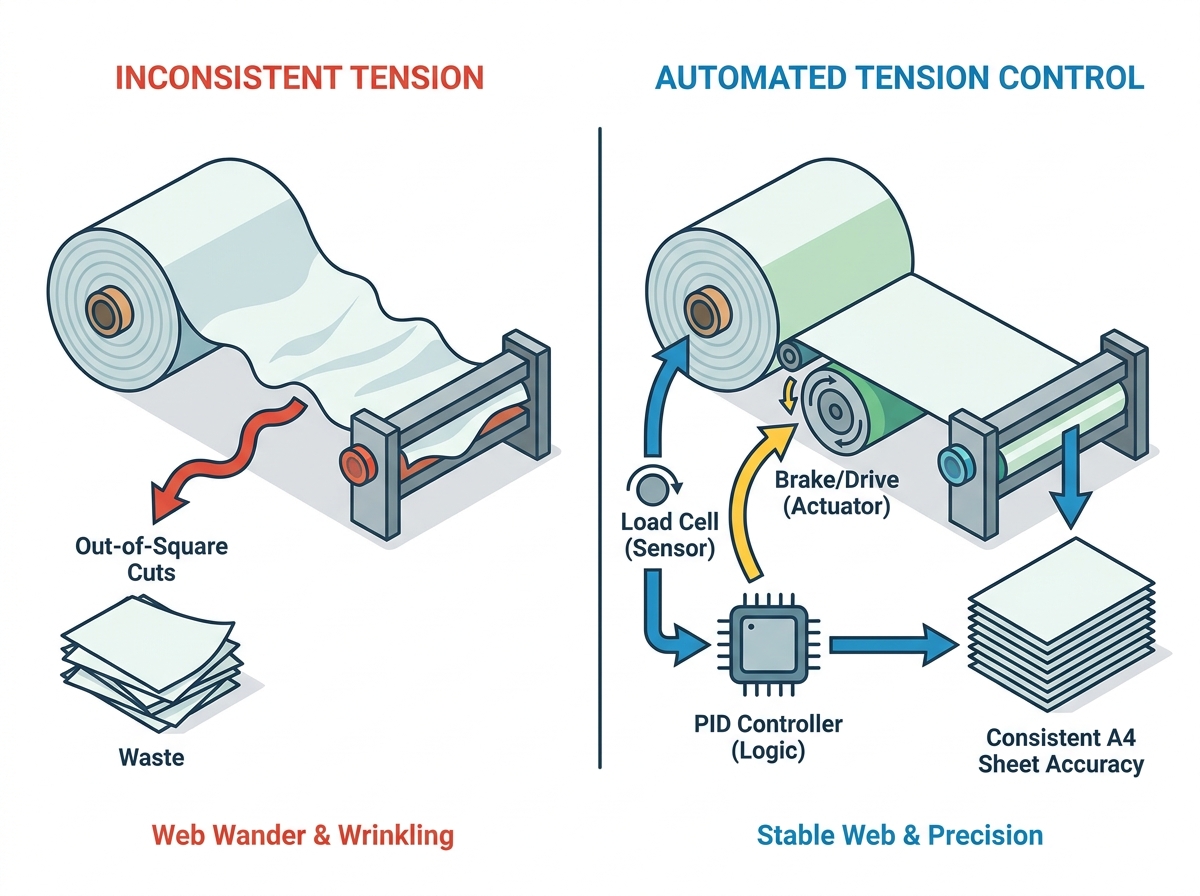
Buyers must differentiate between basic upgrades and true high-performance logic. The distinction directly impacts A4 sheet accuracy. You must know what to scrutinize when reviewing equipment specifications.
Closed-loop control is the non-negotiable standard. Open-loop systems guess the required braking force based solely on roll diameter calculations. They cannot detect actual web stretch. Closed-loop systems measure the actual tension and adjust continuously. You need closed-loop control to maintain strict cutting accuracy at speeds exceeding 200 reams per minute.
| Feature | Open-Loop System | Closed-Loop System |
|---|---|---|
| Feedback Mechanism | None (relies on diameter estimation) | Load cells or dancer arms |
| Accuracy Level | Low to Moderate | Extremely High |
| Response to Disturbances | Cannot correct sudden web stretch | Corrects errors in milliseconds |
| Best Use Case | Low-speed, thick material runs | High-speed A4 paper conversion |
Look past generic "automated" claims. Request hard data on response time and granularity. Ask vendors about the controller's processing speed. You also need to know the physical response time of the braking mechanisms. A fast computer paired with sluggish pneumatic valves will still ruin paper.
Multi-roll synchronization adds another layer of complexity. Modern setups often use 4-roll or 6-roll unwind stands. Each individual web must receive dedicated tension control. The machine must tension each sheet perfectly before they converge into the main cutting section. If one inner web sags, it causes inner-sheet wrinkling. This ruins the entire cut stack.
Finally, evaluate software accessibility through the Human-Machine Interface (HMI). Operators need clear visual feedback. They should see live tension curves on the screen. The HMI must allow users to save specific tension profiles. Different paper grades require drastically different handling parameters. Easy profile loading prevents setup errors.
Upgrading your machinery is rarely as simple as turning it on. The myth of "plug and play" automation costs facilities thousands in wasted material. Even the most advanced tension systems require rigorous initial calibration. You must customize the setup to your specific raw material sources and environmental conditions.
Environmental degradation poses a severe risk to long-term performance. Paper cutting generates massive amounts of airborne dust. Dust and ambient humidity inevitably affect sensor accuracy over time. Optical sensors become blinded. Load cell pivots get sticky. You must implement a strict preventative maintenance schedule to protect your investment.
Do not ignore the mechanical pre-requisites. Upgrading electronic controllers will fail if the underlying machinery is flawed. You must audit your hardware before touching the software.
Operator adoption remains a major hurdle. Veteran operators often rely on manual, "feel-based" adjustments. Shifting them to a digital workflow requires targeted training. They must learn to trust digital tension readouts. Show them how overriding the system manually often worsens the problem. Education ensures the technology actually gets used.
Best Practice: Schedule weekly air-purge cleanings for all load cells and sensors. Establish a baseline zero-calibration routine at the start of every shift.
Selecting the right vendor dictates your long-term success. You must demand proof of capability before signing any contracts. Require vendors to demonstrate tension stability during the most critical phases. Watch how the copy paper cutting line handles rapid acceleration. Observe the emergency deceleration protocols. Pay close attention to the final 10% of the mill roll, where tension is hardest to control.
Demand component transparency from your supplier. Ensure the vendor uses non-proprietary, globally sourced load cells and PLCs. Brands like Siemens or Allen-Bradley offer global support. Proprietary electronics trap you in vendor lock-in. You will face massive delays when ordering spare parts if you buy closed-ecosystem hardware.
Assess the manufacturer’s Service and Support SLAs (Service Level Agreements). Modern tension systems rely heavily on complex code. Your vendor must provide remote diagnostic capabilities. They should be able to troubleshoot algorithmic faults directly through a secure internet connection. This fixes software issues instantly without requiring an expensive site visit.
Perform strict ROI modeling focused on waste reduction. Map the upfront cost of advanced tension control against your projected scrap rates. Calculate the financial value of reducing web breaks by 50%. Measure the savings from eliminating short-sheet rejections. Advanced tension logic pays for itself rapidly through preserved material. Do not view the initial price tag in a vacuum; view it against your current daily waste logs.
Automated tension control bridges the gap between theoretical machine speed and actual sellable yield. Fast equipment is useless if it destroys paper during the process. Dynamic tension regulation ensures every single sheet meets precise dimensional standards.
An investment in a high-tier cutting line is inherently an investment in its tension logic. Compromising here degrades the performance of the entire downstream packaging process. Out-of-square paper jams ream wrappers and frustrates end-users.
Next Steps:
A: Heavier papers require higher running tension to prevent sagging in the web path. Conversely, lower GSM papers are highly susceptible to stretch and web breaks. They require highly responsive, lower-tension setpoints to maintain structural integrity while moving rapidly through the machine.
A: Yes, via aftermarket load cells, a dedicated tension PLC, and upgraded brakes. However, the mechanical integrity of the existing unwind stand dictates the actual success of the retrofit. If the base shafts are misaligned, new electronics will not fix the underlying mechanical drag.
A: The industry standard for high-quality copy paper is typically ±0.2mm. Maintaining this precise tolerance at high speeds is physically impossible without closed-loop tension regulation. The system must ensure the web enters the cross-cutting knife completely flat and mechanically stable.


