 English
- All
- Product Name
- Product Keyword
- Product Model
- Product Summary
- Product Description
- Multi Field Search
English


Views: 0 Author: Site Editor Publish Time: 2025-06-21 Origin: Site


Cutting a roll of paper into sheets is a fundamental operation in many industries such as printing, packaging, publishing, and stationery manufacturing. The ability to efficiently and accurately convert large rolls of paper into standard-sized sheets directly impacts product quality, production speed, and material utilization.
Paper manufacturers and converters typically produce and distribute paper in large rolls, often called jumbo rolls. These rolls can weigh several hundred kilograms and have widths ranging from a few dozen centimeters to several meters. Handling paper in roll form is advantageous for storage and transport, but end users and downstream processes require paper in sheet format.
The conversion from roll to sheet is not as simple as cutting a big roll into smaller pieces. It involves a controlled, precise process that ensures each sheet meets exact size specifications, maintains flatness, and is free from defects such as wrinkles or tears. Industrial cutting lines integrate unwinding mechanisms, tension controls, precise cutting blades, and stacking systems to deliver high-quality sheets ready for further processing.
In a typical production line, the jumbo roll is first loaded onto an unwind stand, where it is slowly and steadily fed into the cutting section. The cutting system slices the continuous web of paper into sheets at predetermined lengths, which are then collected and stacked automatically. This entire operation is usually governed by computerized control systems that optimize speed and accuracy while minimizing waste.
Traditional Paper Cutting Methods
In the past, cutting large paper rolls into sheets was mainly manual or semi-automated. Operators used hand tools like knives, rotary cutters, or guillotine cutters, measuring and marking paper before cutting. Semi-automatic machines offered some help but still relied heavily on manual work.
However, these traditional methods have clear drawbacks:
Accuracy Issues: Human error causes inconsistent sheet sizes and uneven edges.
Low Productivity: Manual cutting limits speed and output.
Material Waste: Misaligned cuts lead to higher scrap rates.
Labor Intensive: Requires significant physical effort and skill.
Safety Risks: Handling sharp blades without automation increases accident chances.
Advantages of Modern Paper Sheeting Machines
Modern machines fully automate the cutting process, offering major advantages:
Precision: CNC blades and sensors ensure exact, consistent cuts.
High Speed: Continuous operation boosts production capacity significantly.
Waste Reduction: Advanced controls optimize material use and minimize scrap.
Safety: Automation reduces direct contact with blades, lowering injury risk.
Consistency: Uniform sheet quality vital for printing and packaging industries.
Flexibility: Programmable for various sheet sizes and paper types, enabling quick changes.
Thanks to these benefits, industries now prefer automated paper sheeting machines to meet fast-paced, high-quality production demands.
Understanding the workflow of a paper sheeting machine clarifies why it is indispensable in modern paper processing.
The process begins by mounting the jumbo paper roll onto the machine’s unwind shaft. This step requires precision because the roll must be properly centered and secured to avoid imbalance during unwinding. Operators check the roll for defects such as moisture spots, tears, or dirt that could affect cutting quality.
Large rolls are often heavy, so cranes or forklifts are used to position them safely. Some machines feature automatic loading systems to reduce manual labor and setup time.
Once the roll is loaded, the machine adjusts the paper tension to maintain an even feed. Tension control is crucial; too much tension can stretch or tear the paper, while too little can cause slack, wrinkles, or misfeeds.
The system employs sensors and braking mechanisms that dynamically adjust tension as the roll diameter decreases during unwinding. Additionally, web alignment rollers ensure that the paper travels straight and true into the cutting section. Precise alignment prevents skewed sheets and maximizes material utilization.
Operators input the desired sheet length, number of sheets, and cutting speed via a user-friendly interface, often a touchscreen control panel. Many machines support programmable memory for multiple jobs, allowing quick switching between different sheet sizes or paper grades.
Cutting speed is carefully calibrated based on paper type and machine capability to maintain edge quality and prevent excessive blade wear.
The paper roll unwinds gradually, feeding the continuous web through a series of rollers that regulate speed and maintain proper tension. Feeding systems are engineered to ensure smooth, vibration-free movement, which is essential for precise cutting.
Some machines have servo motors that precisely synchronize feeding speed with cutting action to avoid tearing or misalignment.
Depending on the machine model and application, different cutting technologies are used:
Single Knife Cutters: A single blade moves up and down to slice sheets at set intervals.
Dual Knife Cutters: Two blades work together for faster and cleaner cuts, especially on thicker papers.
Rotary Shear Cutters: Circular blades rotate continuously, providing smooth cutting at high speeds.
Spiral Cutters: Helical blades cut paper in a spiral fashion, useful for specialty papers or delicate materials.
The cutting action is highly synchronized with the paper feed, ensuring every sheet is uniform in length and cut cleanly without fraying or dust.
After cutting, sheets are automatically transferred to stacking tables or conveyors. These stacking systems neatly pile sheets into bundles for easy handling and transport.
Some advanced machines integrate robotic arms or automated packaging modules that wrap, band, or palletize the stacks, further streamlining the workflow.
Throughout the cutting process, sensors continuously monitor tension, cutting accuracy, and sheet count. Some systems use cameras or laser measuring devices to detect defects or size deviations in real time.
If irregularities are detected, the machine can adjust parameters automatically or alert operators for intervention. This closed-loop control ensures consistent output quality and minimizes downtime due to errors.
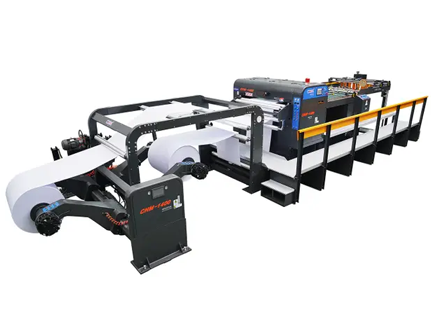
Several technical factors must be carefully managed to achieve optimal cutting performance and product quality.
Proper tension prevents paper from stretching, wrinkling, or tearing. Tension sensors and braking systems dynamically adjust based on roll diameter and feed speed, maintaining a stable web throughout the process.
While increasing cutting speed boosts throughput, too fast a speed can cause rough edges, blade chatter, or paper misfeeds. Operators balance speed and quality depending on paper thickness, coating, and machine capability.
Blade sharpness and design directly affect cut quality. Sharp blades create clean, smooth edges and reduce paper dust. Regular maintenance, sharpening, or replacement is necessary to maintain performance and prevent damage to paper or equipment.
Smooth, vibration-free feeding ensures sheets are cut precisely without skew or size variation. Well-maintained rollers and guides aligned correctly support stable paper movement.
Periodic calibration of sensors, cutters, and feed systems keeps machines within design tolerances. Scheduled preventive maintenance avoids unexpected breakdowns and ensures continuous quality.
Cutting paper rolls into sheets is a complex process that has evolved significantly from manual cutting to fully automated, computer-controlled paper sheeting machines. Modern equipment offers unmatched precision, speed, and safety, enabling industries to meet demanding production requirements while minimizing waste and labor costs.
For manufacturers seeking reliable, high-performance paper sheeting solutions, investing in advanced machinery is essential. Dong Guan Chun Hing Mechanical Technology Co., Ltd. specializes in designing and manufacturing state-of-the-art paper roll sheeter machines that combine robust mechanical engineering with intelligent automation. Their machines deliver precision cutting, flexible operation, and integrated quality control, tailored to diverse paper types and production scales.
To explore their innovative paper sheeting machines or discuss how to optimize your paper processing line, visit their official website at www.chmpapersheeter.com. Contact their expert team to find the perfect solution to enhance your productivity, quality, and operational efficiency.


