 English
- All
- Product Name
- Product Keyword
- Product Model
- Product Summary
- Product Description
- Multi Field Search
English


Views: 0 Author: Site Editor Publish Time: 2026-07-13 Origin: Site


Paper dust in A4 production creates major commercial headaches for paper converters and manufacturers. It directly leads to downstream end-user complaints. Customers frequently report severe copier jams, print image flaws, and voided equipment warranties. You must tackle this problem at the source. Maintaining high edge quality while minimizing particulate generation is a serious operational challenge. This difficulty multiplies rapidly as your production speeds scale up. Your facility needs robust solutions to stay competitive and profitable. This article provides a technical evaluation framework for your engineering team. We will help you assess advanced cutting mechanisms and modern dust extraction technologies. You can use this guide when upgrading or optimizing your converting equipment. By understanding these mechanical variables, you protect your brand reputation. You also secure a stronger, more profitable position in the demanding B2B copy paper market.
Substandard cutting mechanics are the primary generator of paper dust, directly impacting the marketability of the final product.
Achieving clean edge copy paper requires precision synchronization between blade RPM, web tension, and specialized blade metallurgy.
Integrated dust extraction systems are no longer optional for commercial viability; evaluating their vacuum placement and static elimination capabilities is critical.
Upgrading to a modern A4 paper cutting machine requires assessing facility infrastructure, including pneumatic supply and space footprint.
Understanding the business problem begins with observing downstream equipment failures. Micro-dust severely damages commercial printers and heavy-duty office copiers. When poorly cut paper enters these machines, loose particulates rapidly detach. They infiltrate sensitive mechanical zones. These airborne fibers cause sensor blinding, which triggers false paper jam alerts. Furthermore, dust accumulation accelerates fuser roller degradation. This leads to costly maintenance calls for your clients. Commercial buyers track these metrics closely. B2B clients will routinely reject entire batches if they identify your paper as the source of their equipment downtime.
Print quality degradation presents another major commercial hurdle. Paper dust directly interferes with the toner or ink transfer process. When micro-dust rests on the paper surface during printing, it blocks the ink. This mechanical interference causes "hickies" and visible voids in the final print images. End-users notice these blemishes immediately. They associate degraded image clarity with low-quality paper stock. If you want to command premium pricing, you must eliminate these surface particulates before the reams reach the packaging wrapper.
Facility health and safety considerations also demand immediate attention. Airborne combustible dust poses a hidden risk inside your converting facility. Paper fibers are highly flammable when suspended in enclosed air spaces. Regulatory bodies maintain strict compliance standards for airborne particulate levels. Mitigating this dust at the cutting source ensures operational safety. It protects your operators from respiratory hazards. It also shields your business from compliance fines and potential safety shutdowns.
Consider these primary downstream impacts on commercial print environments:
Optical Sensor Failure: Dust coats paper path sensors, causing phantom jams.
Toner Adhesion Issues: Loose fibers prevent toner from fusing smoothly to the page.
Roller Slippage: Dust acts as a dry lubricant, making feed rollers slip and misfeed.
Shortened Maintenance Cycles: End-users must service their printers twice as often.
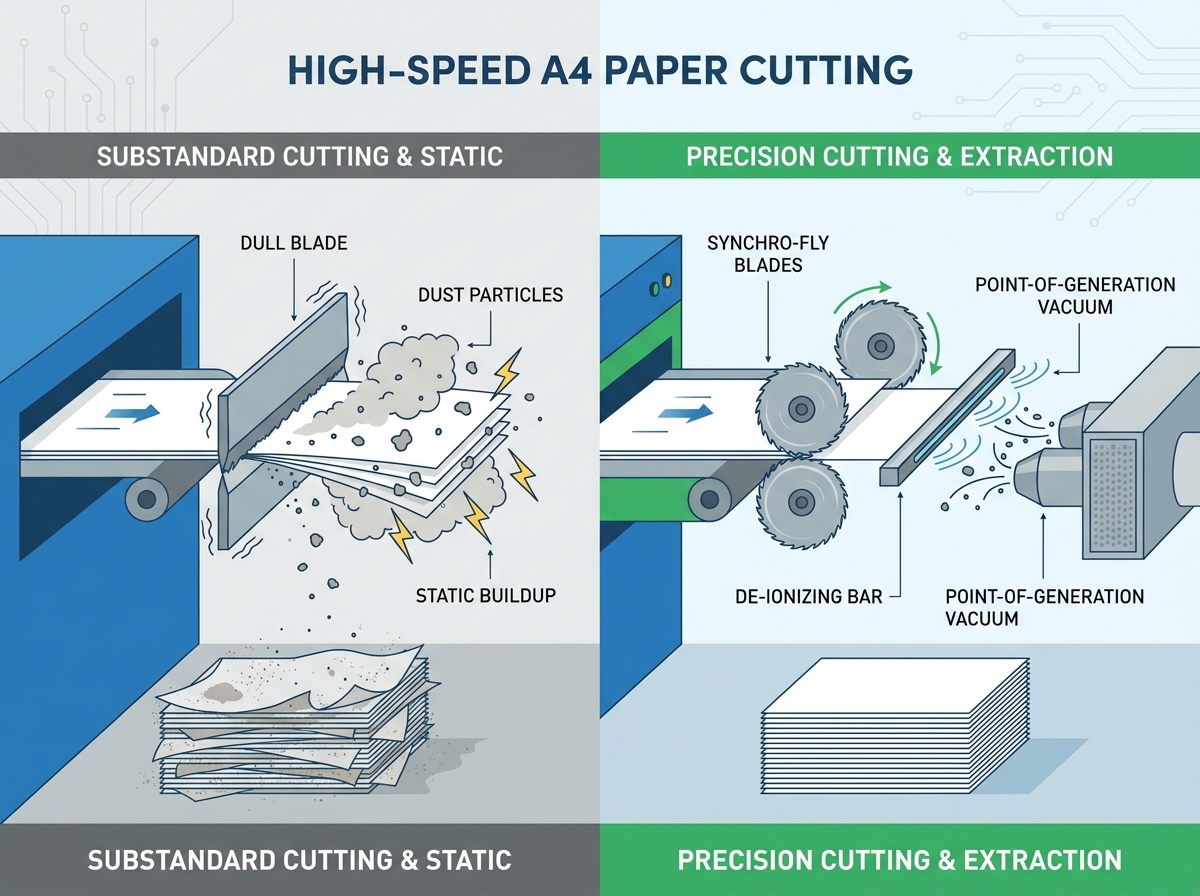
To solve particulate contamination, you must understand the physics of the cut. A massive difference exists between a clean shear and a crush-cut. A proper shear action slices through the paper web with absolute precision. It parts the fibers cleanly. Conversely, improper blade angles create a crushing force. Inadequate web tension exacerbates this problem. Instead of slicing seamlessly, the blades force the paper fibers to tear. This violent tearing action rips the fiber bonds apart. It generates localized dust clouds right at the cutting zone.
Vibration and speed tolerances play a critical role in edge quality. Older or entry-level converting machines often fail to dampen mechanical vibrations. As operational speeds increase, these micro-vibrations transfer directly to the cutting head. The blades then chatter against the paper web. This microscopic bouncing causes tiny, jagged micro-tears along the paper edge. Operating a modern high speed paper cutter requires immense frame rigidity. Without a solid cast-iron base to absorb vibrations, high RPMs will always yield dusty, low-quality reams.
Static electricity buildup acts as a magnet for these loose fibers. High-speed web movement generates significant friction. As the paper unrolls and travels over idler rollers, it builds a strong triboelectric charge. This static charge physically binds the newly created paper dust to the freshly cut sheets. The particulates cling stubbornly to the surface. Because the static bond is so strong, standard ambient extraction fans become completely ineffective. You cannot simply blow this dust away; you must first break the electrical bond holding it there.
Common operational mistakes that worsen dust generation include:
Running the machine faster than the web tension controllers can handle.
Ignoring early warning signs of blade chatter.
Failing to monitor ambient humidity, which worsens static buildup.
Delaying routine maintenance on the cutting head bearings.
Blade metallurgy dictates your long-term success in reducing particulates. Standard tool steel blades are common in budget machinery. They lose their micro-edge quickly under continuous shifts. As they dull, they begin to crush rather than cut. Upgrading your A4 cutting blades to specialized tungsten carbide or high-speed steel (HSS) changes the equation. These premium metals offer vastly superior wear resistance. This durability correlates directly with sustained edge sharpness. A sharper blade guarantees prolonged paper dust reduction across millions of cuts.
The cutting mechanism itself is equally important. You must analyze the mechanical advantage of double rotary, or synchro-fly, systems. Older stationary bed knife systems drag the paper slightly during the cut. This friction causes edge fracturing. In contrast, synchro-fly systems use two rotating blade drums. They synchronize their blade speeds to perfectly match the moving web velocity. The blades meet the paper at the exact speed it travels. This prevents paper bunching, eliminates dragging, and ensures perfectly square edges.
You must also establish trustworthy expectations regarding maintenance realities. Even the highest-grade blades require strict maintenance schedules. You cannot install carbide blades and forget them. They require precise sharpening intervals to consistently produce clean edge copy paper. Your maintenance team must calibrate the blade gap using specialized micrometer tools. A gap offset by just a fraction of a millimeter will instantly degrade the cut quality and generate excessive dust.
Blade Material | Wear Resistance | Dust Generation Impact | Recommended Use Case |
|---|---|---|---|
Standard Tool Steel | Low to Moderate | High as edges dull rapidly | Short runs, low-speed legacy machines |
High-Speed Steel (HSS) | High | Consistently low with maintenance | Mid-to-high speed continuous production |
Tungsten Carbide | Exceptional | Minimal over extended periods | 24/7 high-volume premium paper converting |
Modern equipment relies heavily on point-of-generation vacuum systems. You cannot rely on ambient room filters. An effective extraction system must target the exact moment of the cut. Extraction nozzles must be positioned mere millimeters from the cutting shear point. This strategic placement captures dust before it has a chance to disperse into the surrounding air. If the nozzle sits too far back, the turbulence from the moving paper will blow the particulates away. Precision placement guarantees maximum capture efficiency.
De-ionization is a critical partner to vacuum extraction. High-end machines pair de-ionizing bars with their vacuum systems to combat static. As we noted earlier, static physically glues the dust to the paper. Active de-ionizing bars flood the cutting zone with neutralizing ions. They break the static bond instantly. Once the electrical charge dissipates, the paper releases the dust. The vacuum system can then easily pull the loose fibers away from the web.
You must also evaluate the filtration and air handling capacity of the equipment. We measure this in Cubic Feet per Minute (CFM). A robust A4 paper cutting machine requires high CFM ratings to maintain negative pressure across the entire cutting width. Furthermore, self-cleaning filter mechanisms are vital. Continuous continuous shifts generate massive volumes of dust. Standard filters clog quickly, causing immediate suction loss. Reverse-pulse cleaning systems blast air back through the filters. This shakes the dust into a collection bin, ensuring uninterrupted suction performance.
Key features of an effective extraction setup include:
Proximity nozzles mounted directly parallel to the cross-cutting blades.
High-voltage de-ionizing bars placed immediately before and after the cut.
Variable speed blowers to adjust suction based on paper weight.
Automated waste silos with continuous bag-out systems.
Upgrading your facility requires careful planning regarding physical integration. High-capacity extraction systems require dedicated floor space. You will likely need external dust collection silos positioned outside your main production hall. Additionally, you must assess your HVAC and compressed air infrastructure. Self-cleaning filters consume significant volumes of dry, compressed air. Your pneumatic supply lines must handle this increased load without dropping pressure to other critical machine components.
Operator training represents another significant transition curve. Modern automated systems demand a workflow shift. Your team must move away from manual mechanical adjustments. New operators will rely on software-driven tension controls and digital blade-gap calibration. They need extensive training to understand these touchscreen interfaces. A highly advanced machine will still produce dusty paper if the operator inputs the wrong web tension parameters.
Finally, consider the return on investment through improved operational efficiency. Capital expenditure for integrated extraction systems and synchro-fly technology is undeniably high. However, you realize substantial ROI through drastic paper dust reduction. Clean machinery experiences far less maintenance downtime. Premium blades last significantly longer before requiring replacement. Most importantly, producing truly dust-free paper allows you to secure premium pricing contracts with demanding B2B clients. The reduction in rejected batches alone often justifies the initial equipment upgrade.
The link between precision cutting mechanics, integrated extraction, and end-product quality is absolute. You cannot produce premium copy paper on substandard machinery. Poorly synchronized blades and inadequate web tension will always tear paper fibers. This generates damaging particulates that ruin commercial printers and damage your brand reputation.
Minimizing paper dust is a systemic equipment challenge. It is not just a housekeeping issue or a simple cleaning routine. Achieving flawless edges requires specialized metallurgy, synchro-fly mechanics, and aggressive point-of-generation static elimination.
As you shortlist potential equipment vendors, take actionable next steps. Demand comprehensive vendor demonstrations. Bring your own problematic paper stock to their facilities. Request live sample cuts at maximum operational speeds. Always demand quantifiable dust-extraction performance metrics before finalizing any major machinery purchase.
A: Rough edges result directly from improper cutting mechanics. Dull cutting blades, incorrect cutting angles, and excessive web tension are the main culprits. Instead of slicing seamlessly, the blades force the paper to crush. This violent action causes the paper fibers to tear, resulting in jagged, dusty edges rather than a smooth, clean finish.
A: You should expect realistic benchmarks. While 100% elimination is scientifically impossible, modern upgrades deliver massive improvements. Advanced extraction systems paired with synchro-fly cutters typically mitigate 90-95% of loose particulates. This drastic reduction virtually eliminates downstream printer jams and keeps the converting environment safe and clean.
A: Retrofitting is physically possible but often limited in effectiveness. Aftermarket nozzles usually lack the necessary millimeter-level proximity to the cutting blades. Furthermore, retrofits struggle to integrate synchronized static elimination seamlessly. Purpose-built machines design the chassis around the extraction system, capturing dust far more efficiently than bolt-on aftermarket solutions.


