 English
- All
- Product Name
- Product Keyword
- Product Model
- Product Summary
- Product Description
- Multi Field Search
English


Views: 0 Author: Site Editor Publish Time: 2026-06-26 Origin: Site


Transitioning roll stock to flat sheets in-house is a high-stakes capital expenditure. Upgrading legacy equipment directly impacts yield, print registration, and bottom-line margins. You need industrial converting equipment capable of handling massive continuous throughput without sacrificing exact tolerances. Substandard sheeting quickly leads to dimensional inaccuracies, excessive paper dust, and curled edges. These mechanical issues cause downstream downtime, effectively eroding the initial cost benefits of buying paper in large master rolls. You lose valuable production hours clearing feeder jams and cleaning offset press blankets.
Therefore, a reliable procurement decision requires looking past superficial top-line speed metrics. You must rigorously evaluate the equipment's tension control systems, knife architecture, and overall operational flexibility against your specific facility requirements. We will explore how to align these essential technical capabilities. By focusing on mechanical precision and operator safety, you can ensure a successful, highly profitable equipment upgrade.
Application Dictates Architecture: A paper sheeter for printing prioritizes strict dimensional tolerances and dust-free edges, while paper sheeting for packaging often demands robust handling for higher GSM boards.
Twin-Rotary vs. Single Rotary: Twin-rotary knives provide superior cut quality and handle heavier materials without edge distortion, though they require a higher initial investment.
Hidden TCO Factors: Evaluate machines based on changeover times, parts availability, and automated tension control rather than just maximum cuts-per-minute.
Implementation Realities: Successful deployment requires precise floor leveling, adequate power infrastructure, and robust operator training to mitigate adoption risks.
Before reviewing technical specifications, you must identify the primary goal behind the investment. Are you trying to reduce outsourced converting costs? Perhaps you want to minimize material waste during long runs. Many facilities also seek to expand their product offerings by producing custom sheet sizes on demand. Mapping these goals to specific operational bottlenecks clarifies your required equipment features. A facility focused on waste reduction will prioritize advanced web alignment tools over absolute top speed.
Different materials demand entirely different handling mechanisms. When evaluating a paper sheeter for printing, extreme squareness and flawlessly clean edges are paramount. Offset and digital presses run at high speeds. Dusty edges or slight diagonal misalignments quickly cause severe feeder jams. Dust also leads to blanket contamination, requiring frequent press stops for cleaning.
Conversely, paper sheeting for packaging requires heavy-duty material handling. Packaging workflows process folding cartons, coated boards, and varying calipers. The machine must grip and transport these thick substrates without causing surface scuffing or edge delamination. The transport belts and delivery stacking systems must accommodate heavier physical weights without faltering.
Vague expectations lead to poor procurement decisions. Define clear, quantifiable metrics for the investment before soliciting vendor proposals. These benchmarks keep the project focused and provide objective evaluation standards.
Reduce overall raw material waste percentages by a specific target (e.g., 4%).
Consistently achieve a cut accuracy of ±0.5mm across all standard substrates.
Decrease average job changeover time to under 15 minutes.
Eliminate downstream press stops caused by paper dust.
Increase total daily sheet volume by 25% compared to legacy machinery.
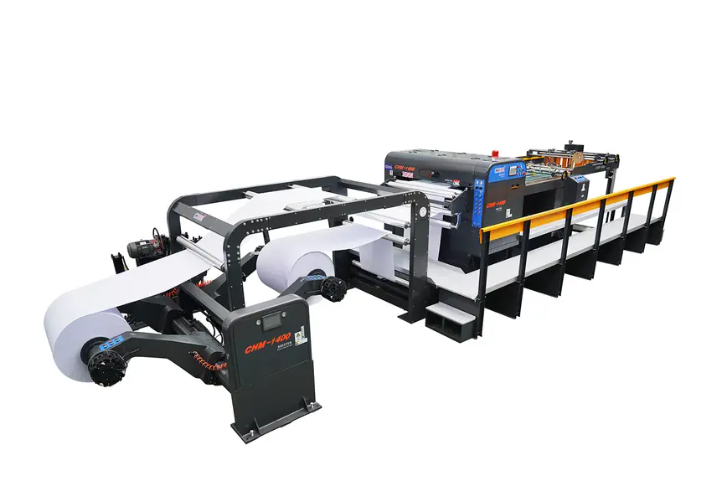
Understanding the fundamental mechanical differences in modern roll to sheet cutting machine technology is crucial. The cutting mechanism and physical configuration dictate both material compatibility and workflow efficiency.
Single rotary sheeters feature one moving blade mounted on a rotating cylinder, cutting against a fixed stationary anvil. They are budget-conscious solutions and perform exceptionally well for lighter papers. However, their physical mechanics have limitations. When processing thicker stocks, single rotary systems often create a slight bevel on the cut edge.
Twin rotary systems use a synchronous scissor-like action. They feature two rotating drums with mounted blades meeting exactly at the web speed. This synchronization prevents the paper from buckling during the cut. Twin rotary architecture is strictly necessary for high-GSM board. It significantly reduces dust generation and delivers the pristine edge quality required for commercial offset printing.
Feature | Single Rotary Knife | Twin Rotary (Synchronous) Knife |
|---|---|---|
Mechanism | One rotating blade, one fixed anvil | Two rotating drums, synchronized blades |
Best Material | Light to medium paper (up to ~300 GSM) | Heavy paper and board (up to 1000+ GSM) |
Edge Quality | Good, but may bevel on thick stocks | Excellent, precise, square edge |
Dust Generation | Moderate | Very low |
Investment Level | Lower initial cost | Higher initial cost |
Inline configurations integrate directly with web presses or coaters. They offer a continuous, streamlined workflow. Once the web is printed or coated, it moves immediately into the cutting section. The main drawback is dependency. If the sheeter jams, the entire main production line stops.
Offline, or stand-alone, configurations run independently. They are fed by multiple unwind stands holding pre-printed or blank master rolls. Offline setups provide maximum flexibility. You can process high volumes from various sources without tying the cutter to one specific printing press.
The unwind stand feeds the master roll into the cutting section. Shafted unwind stands require operators to insert a heavy steel shaft through the roll's core. This process is highly manual and time-consuming.
Shaftless unwind stands use mechanical chucks to grab the roll core from the sides. Motorized arms lift the roll off the floor directly into position. Shaftless automation drastically reduces roll loading times. It also significantly improves workplace safety by eliminating heavy manual lifting.
Evaluating equipment requires looking deeply at specialized sub-systems. Consistent precision sheet cutting relies on several synchronized modules working flawlessly together at high speeds.
Paper stored in rolls develops a strong mechanical memory, causing it to curl. Delivering flat sheets to the delivery stack is non-negotiable. Curled sheets will instantly jam downstream folding machines or presses. Automated web tension systems maintain constant pull on the paper. Multi-station decurlers draw the tensioned web over varying diameter rollers. This process breaks the material's memory, ensuring perfectly flat sheets upon delivery.
True precision relies on sophisticated electronics. Modern sheeters use servo-motor synchronization to control the knife drums. These motors adjust micro-seconds before the cut to match web speed perfectly. You should expect the machine to consistently maintain tight tolerances between ±0.15mm and ±0.5mm. This accuracy must hold steady even as the machine accelerates or decelerates.
Longitudinal cuts require high-quality slitter blades positioned before the cross-cutting knives. These slitters must create razor-sharp edges without generating loose fibers. Additionally, efficient vacuum systems are necessary to pull away edge trim instantly. If trim ribbons snap or tangle in the rollers, the machine must shut down to clear the jam.
Throughput is bottlenecked by how fast you can remove finished stacks. Advanced delivery sections feature auto-pallet changes. Once a stack reaches a predetermined height, the machine temporarily suspends the sheets, swaps the pallet, and resumes dropping sheets. Vibration joggers continually tap the sides of the descending paper, aligning the stack perfectly. Tag-inserters automatically shoot small paper tabs into the pile to separate reams for easier downstream handling.
Industrial converting equipment poses significant physical hazards. Ensure the machinery meets strict regional safety compliance, such as CE marking or OSHA standards. Look for non-bypassable light curtains around moving parts. Emergency stops must be abundant and easily reachable. Sound dampening enclosures over the cutting section protect operator hearing and reduce factory noise pollution.
Purchasing the hardware is only the first phase. Integrating a heavy-duty paper sheeting machine requires significant logistical preparation. Failing to prepare the facility leads to delayed deployments and budget overruns.
These machines require massive spatial footprints. You must account for the primary machine length, which often exceeds 10 meters. Furthermore, roll staging areas demand extensive surrounding room for forklift maneuverability. The physical weight of heavy twin-rotary units requires specialized floor engineering. Standard concrete floors may lack the necessary load-bearing capacities. You may need to pour reinforced concrete pads to prevent machine settling, which destroys cut alignment over time.
Heavy machinery draws immense electrical loads. Detail the necessity of stable, high-phase electrical inputs with your utility provider early in the project. Voltage drops will cause servomotors to lose synchronization. Additionally, pneumatic brakes and tensioners require dedicated, clean compressed air lines. Moisture or oil in the air lines will degrade pneumatic seals and cause tension fluctuations.
Complex human-machine interfaces (HMIs) pose a severe adoption risk. If operators cannot understand the controls, they will run the machine slowly to avoid errors, resulting in severe under-utilization. Prioritize vendors offering intuitive touchscreens. Programmable job memory is highly valuable. It allows operators to save tension, decurler, and cut length settings for specific paper grades, reducing manual setup errors.
High-speed rotating equipment demands rigorous upkeep. You must commit to realistic maintenance schedules to protect the asset.
Blade Sharpening: Monitor edge wear and schedule sharpening intervals before cut quality noticeably degrades.
Servo Calibration: Periodically verify electronic synchronization to maintain dimensional accuracy.
Lubrication: Adhere strictly to the manufacturer's greasing schedule for main bearings and gears.
Filter Replacement: Keep pneumatic and vacuum filters clean to maintain optimal air pressure.
Procuring capital equipment involves evaluating the manufacturer just as harshly as the machine itself. A structurally sound machine becomes a liability if the manufacturer cannot support it.
Machine downtime costs thousands of dollars per hour. Scrutinize the vendor's Service Level Agreements (SLAs). Define their expected response times for technician dispatch. Prioritize vendors who offer remote diagnostic capabilities. Many modern machines allow manufacturer engineers to log into the PLC remotely. They can diagnose electronic faults and push software patches immediately, saving days of physical travel time.
Assess whether the manufacturer uses standardized, locally sourceable electronics. Systems built using widely available components, such as Siemens or Allen-Bradley PLCs, provide long-term security. If a motor drive fails, you can source a replacement from a local industrial supplier. Conversely, proprietary locked systems force you to buy exclusively from the manufacturer, often resulting in heavy markups and long overseas shipping delays.
Never rely solely on brochure specifications. Speak directly with existing customers processing similar GSM ranges. Ask them to verify the claimed machine speeds against real-world, day-to-day production. Ask about their experiences with edge dust and blade longevity. Candid feedback from actual users is the most accurate predictor of a machine's true capability.
Structure a demanding Request for Proposal (RFP). Before signing any purchase orders, require the vendor to conduct material testing. Send them master rolls of your most difficult substrates. Demand unedited video proof of the machine processing your material at the promised speeds. Finally, insist on guaranteed tolerance matrices written directly into the contract.
Procuring the optimal paper sheeting machine requires balancing strict cut precision with real-world operational flexibility. The right equipment transforms master rolls into press-ready sheets seamlessly, eliminating downstream jams and protecting your margins. Always root your decision in actual material data and verified vendor support capabilities.
Avoid the common pitfall of over-specifying. Buying extreme top speeds your facility cannot adequately feed wastes capital. Similarly, avoid under-specifying. Sacrificing edge quality by pushing a single-rotary machine to cut heavy board will result in rejected orders. Define your metrics clearly, demand material testing, and prioritize robust maintenance support to ensure a highly successful equipment integration.
A: Single rotary machines typically max out around 300 GSM before cut quality degrades. Twin rotary machines easily handle up to 1000+ GSM. The synchronized scissor action cuts thick packaging board cleanly without creating edge bevels.
A: Decurlers break the paper's physical memory. They pull the tensioned web tightly over varying diameter rollers in the opposite direction of the roll curl. This mechanical manipulation forces the fibers to lay flat before cutting.
A: Yes, twin-rotary setups handle varied calipers well. However, processing drastically different materials requires significant changeover time. Operators must meticulously adjust blade clearances, tension settings, and decurler penetration to match the new material profile.
A: Expect realistic timelines of 3 to 6 months. This period covers custom manufacturing, international shipping, physical installation, and comprehensive operator training. Specialized customized builds may stretch lead times even further.


